Porsche’s product development cycles are unlike other manufacturers. They introduce few models and keep them in circulation for many years. That necessitates an occasional upgrade of a current model. Think of how many iterations the 911 has been through…
We had the opportunity to re-experience the wiles of the Boxster at the completely renovated Circuit de Mont Tremblant racetrack just north of Montreal in Canada. This is truly a beautiful area and the track was similarly well suited for this type of drive. This part of Canada is in the Laurentien Mountains. Geologically, these are very old worn down mountains and often look like very large tree covered hills. The landscape, however, is what seems to be a never-ending series of rolling hills, forests, lakes and greenery…a perfect place for a road course.
On hand at the track were 3 well-experienced champion race drivers. As we sped through the countryside and over the track, it was reinforced yet again that the dominant gene in Porsche’s DNA pool is performance. That capability above all else is so fundamentally bred into the vehicle that roads and tracks that would severely challenge another vehicle, are easy and comfortable for the Boxster. Dips, corners, curves and swells are what this roadster was built for. It begs for a chance to sweep around a bend, crest a rise or attack an S curve. One of the things our pro drivers taught me was how important comfort is in a racecar. Having done the 24 hour endurance races at Daytona and LeMans they’ll tell you that not all race cars are equally refined and comfortable. Many can go fast but they beat up the driver in the process. Porsche’s as it turns out are very fast and very comfortable.
When driving a Boxster on a racetrack, it must be done with the top down. It’s all part of the overall sensory experience. You need to feel the movement of the car. You have to bond with the machine and the elements. Though the tachometer is the most dominant gauge in the most visible position on the dashboard, you shift gears by listening to the engine…you’re too busy driving to look down. You’ve got to congratulate the Porsche engineers who control the machine-driver interfaces. Not only does the machine perform well according to the numbers, but it also evokes such passion while driving it that you just want to own one yourself. Studies show that the single greatest factor in owner satisfaction is whether they “LIKE” driving their vehicle or not. Owners will overlook a surprising number of other vehicle shortcomings if they like their car. I guess that’s why Porsche enjoys such a loyal customer following.
The Boxster is the mid-engined Porsche. The horizontally opposed flat 6 is positioned ahead of the transaxle thus maintaining perfect balance and harmony in this little piece of the automotive universe. The cockpit will hold 2 comfortably and there is both a front and rear luggage compartment. The seating is superbly supportive and comfortable. The interior styling is sporty, classic and elegant. The 2003 interior has a new look, more similar to the 911 than before. The audio system is also upgraded and the optional Bose system is now powerful enough to compete with the wind during open top driving.
Though the Boxster is the “entry” level Porsche, it possesses all the sporting pedigree of the brand that its more expensive and more exotic siblings have. It is just as fun to drive and even though its terminal velocity is lower than the others in the line, it’s more than enough for the city streets where most of us spend our time. Add to that the fact that it is one of the best looking sports cars available, and you can understand the appeal.
by Kelly Foss
www.car-data.com
Showing posts with label Porsche. Show all posts
Porsche 911 - Celebrates 60 years with two new 911 Carrera Coupes
When I was starting out as an auto writer, the annual introduction of new Porsche 911 models always confused me. To my untrained eye, the new models often looked just like the previous year’s models they replaced. While my eye for automotive detail has grown sharper over the years, the challenges for differentiating one model year 911 from the next still remain.
True to form, to celebrate the German company’s 60th anniversary of building fast cars, the two new 2009 Carrera models that are now heading to dealer showrooms look ever so close to the 2008s. But not to worry: Porsche aficionados will soon discover that these quintessential 911s have been especially engineered to mark this magnificent manufacturing milestone and are the most sophisticated, potent and environmentally friendly 911 Carrera models that the company has ever produced.
Despite their abundance of 21st century technologies, the 2009 911 Carrera Coupe and Carrera S Coupe clearly trace their engineering and aesthetic roots to the seminal Porsche. That original car evolved for over 15 years beginning in 1948 as the highly coveted 356. Then at the 1963 Frankfurt Motor Show, the groundbreaking 911 Coupe debuted as a 1964 model. As a testament to the genius of its design, after more than 40 years of development and six generations of engineering improvements, the 911 Carreras still showcase a horizontally opposed, rear-mounted six-cylinder engine carried in a distinctive and instantly recognizable body.
Though the new 911 Carrera and Carrera S Coupes boast several important refinements over the 2008 cars, the cars carry the same internal 997 designation as their immediate predecessors. Chief among those refinements are new, more powerful and fuel-efficient engines and the availability of Porsche's seven-speed double-clutch transmission, the PDK, in place of the optional Tiptronic S. Other critical changes include larger, more potent brakes, a revised Porsche Communication Management system with Bluetooth connectivity and available voice commands, a fresh exterior with BI-XENON™ headlights, and light-emitting-diode rear lighting.
Both the 911 Carrera Coupe and 911 Carrera S Coupe receive new engines that feature direct fuel injection, new two-piece crankcases and revised intake and exhaust systems along with Porsche VarioCam Plus intake-valve timing and lift system. Thanks to a 6.2 percent increase in horsepower, the 3.6-liter engine goes from 325 to 345 hp. When the car is equipped with the new PDK double-clutch transmission in place of last year's Tiptronic S, the 911 Carrera Coupe accelerates from 0 to 60 mph in 4.5 seconds, more than a full half second quicker than its predecessor.
The 3.8-liter engine in the more potent 911 Carrera S Coupe exhibits equally awesome results sprinting to 60 mph in only 4.5 seconds when equipped with a manual gearbox, and making that run in a mere 4.3 seconds with the PDK. This blazing acceleration comes by way of the new 3.8-liter 385 hp engine. Despite the substantial increases over the predecessor models, neither the 2009 3.6-liter 911 Carrera Coupe nor the 3.8-liter 911 Carrera S Coupe carries the stigma of a gas-guzzler penalty. Better yet, both qualify as low emissions vehicles!
And even the most seasoned gear-head might find it surprising to learn that while the new 911 is equipped with two clutches, there’s no clutch pedal. While it is way too complicated to explain the mechanics of how all that works here, Porsche engineers said that in order to take full advantage of the newly designed engines, they decided to offer drivers a transmission that delivers quicker acceleration than is possible with the standard manual gearbox, while maximizing fuel efficiency. The new PDK (from the German Porsche-Doppelkupplungsgetriebe), or Porsche double-clutch transmission, replaces the Tiptronic S as the optional gearbox in both the 911 Carrera Coupe and 911 Carrera S Coupe. The seven-speed PDK allows the driver to shift up and down automatically, or he or she may opt to shift via steering wheel mounted paddles or the console-mounted lever, as with the Tiptronic S. If you’re a bit confused by all this techno talk, all you really have to know is this: the PDK is one of the world’s most sophisticated racing transmissions that enable this Porsche to go really fast, really quick!
When it comes to stopping, Porsche engineers firmly believe that a car's deceleration ability must always out-perform its ability to accelerate. That said, the both new 911 models receive added braking capability and are now equipped with the same sophisticated brake system previously used only on Porsche's very powerful all-wheel-drive models.
As significant as are the changes in the Carrera Coupes' drivetrains this year from last, the exterior differences are, as always, most subtle. Porsche's designers allowed only minor refinements to the appearance of the model range for 2009. When viewed head on, the most notable differences are the new, horizontal covers for the BI-XENON™ headlights and the L.E.D. daytime running lights, which extend over the air inlets. Also noteworthy are air vents, which boast larger cooling openings. The keen-eyed observer will also note the absence of a center radiator on cars equipped with the PDK. The side view reveals new, larger exterior mirrors with aerodynamic twin-arm mounts, as well as new lightweight alloy wheels. Each car's wheels are of a distinct design. In the rear, all the lighting elements are now light-emitting diodes, for improved luminosity, longer life and instantaneous response. Finally, in the back, the 911 Carrera Coupe sports two single oval exhaust pipes while the 911 Carrera S Coupe shows dual round polished exhaust outlets.
Interior refinements include a revamped center console highlighted by a new Porsche Communication Management system (PCM) and the availability of ventilated front seats. The optional navigation module now has a 40 GB hard drive and may be operated with optional voice commands. Other available features include an internal GSM mobile phone module with Bluetooth handsfree operation, as well the ability to connect with external music sources such as iPods or USB memory sticks. As before, the cabin offers its occupants the protection of six airbags: dual frontal-impact airbags; as well as two seat-mounted, thoraxprotecting, side-impact airbags; and two head-protecting, side-impact curtain, door-mounted airbags.
Bottom line: Both 2009 Carreras satisfy the need for speed with world-class performance. Indeed, when it comes time to serve this master of seductive Autobahn speeds by furiously flogging the shift paddles to push this willing and obedient model to its upper limits, design lines become blurred in an unrestrained and seemingly never ending power exchange of double pumping clutch action that only Porsche’s 60th anniversary 911s can deliver.
By John Peige
MyCarData
True to form, to celebrate the German company’s 60th anniversary of building fast cars, the two new 2009 Carrera models that are now heading to dealer showrooms look ever so close to the 2008s. But not to worry: Porsche aficionados will soon discover that these quintessential 911s have been especially engineered to mark this magnificent manufacturing milestone and are the most sophisticated, potent and environmentally friendly 911 Carrera models that the company has ever produced.
Despite their abundance of 21st century technologies, the 2009 911 Carrera Coupe and Carrera S Coupe clearly trace their engineering and aesthetic roots to the seminal Porsche. That original car evolved for over 15 years beginning in 1948 as the highly coveted 356. Then at the 1963 Frankfurt Motor Show, the groundbreaking 911 Coupe debuted as a 1964 model. As a testament to the genius of its design, after more than 40 years of development and six generations of engineering improvements, the 911 Carreras still showcase a horizontally opposed, rear-mounted six-cylinder engine carried in a distinctive and instantly recognizable body.
Though the new 911 Carrera and Carrera S Coupes boast several important refinements over the 2008 cars, the cars carry the same internal 997 designation as their immediate predecessors. Chief among those refinements are new, more powerful and fuel-efficient engines and the availability of Porsche's seven-speed double-clutch transmission, the PDK, in place of the optional Tiptronic S. Other critical changes include larger, more potent brakes, a revised Porsche Communication Management system with Bluetooth connectivity and available voice commands, a fresh exterior with BI-XENON™ headlights, and light-emitting-diode rear lighting.
Both the 911 Carrera Coupe and 911 Carrera S Coupe receive new engines that feature direct fuel injection, new two-piece crankcases and revised intake and exhaust systems along with Porsche VarioCam Plus intake-valve timing and lift system. Thanks to a 6.2 percent increase in horsepower, the 3.6-liter engine goes from 325 to 345 hp. When the car is equipped with the new PDK double-clutch transmission in place of last year's Tiptronic S, the 911 Carrera Coupe accelerates from 0 to 60 mph in 4.5 seconds, more than a full half second quicker than its predecessor.
The 3.8-liter engine in the more potent 911 Carrera S Coupe exhibits equally awesome results sprinting to 60 mph in only 4.5 seconds when equipped with a manual gearbox, and making that run in a mere 4.3 seconds with the PDK. This blazing acceleration comes by way of the new 3.8-liter 385 hp engine. Despite the substantial increases over the predecessor models, neither the 2009 3.6-liter 911 Carrera Coupe nor the 3.8-liter 911 Carrera S Coupe carries the stigma of a gas-guzzler penalty. Better yet, both qualify as low emissions vehicles!
And even the most seasoned gear-head might find it surprising to learn that while the new 911 is equipped with two clutches, there’s no clutch pedal. While it is way too complicated to explain the mechanics of how all that works here, Porsche engineers said that in order to take full advantage of the newly designed engines, they decided to offer drivers a transmission that delivers quicker acceleration than is possible with the standard manual gearbox, while maximizing fuel efficiency. The new PDK (from the German Porsche-Doppelkupplungsgetriebe), or Porsche double-clutch transmission, replaces the Tiptronic S as the optional gearbox in both the 911 Carrera Coupe and 911 Carrera S Coupe. The seven-speed PDK allows the driver to shift up and down automatically, or he or she may opt to shift via steering wheel mounted paddles or the console-mounted lever, as with the Tiptronic S. If you’re a bit confused by all this techno talk, all you really have to know is this: the PDK is one of the world’s most sophisticated racing transmissions that enable this Porsche to go really fast, really quick!
When it comes to stopping, Porsche engineers firmly believe that a car's deceleration ability must always out-perform its ability to accelerate. That said, the both new 911 models receive added braking capability and are now equipped with the same sophisticated brake system previously used only on Porsche's very powerful all-wheel-drive models.
As significant as are the changes in the Carrera Coupes' drivetrains this year from last, the exterior differences are, as always, most subtle. Porsche's designers allowed only minor refinements to the appearance of the model range for 2009. When viewed head on, the most notable differences are the new, horizontal covers for the BI-XENON™ headlights and the L.E.D. daytime running lights, which extend over the air inlets. Also noteworthy are air vents, which boast larger cooling openings. The keen-eyed observer will also note the absence of a center radiator on cars equipped with the PDK. The side view reveals new, larger exterior mirrors with aerodynamic twin-arm mounts, as well as new lightweight alloy wheels. Each car's wheels are of a distinct design. In the rear, all the lighting elements are now light-emitting diodes, for improved luminosity, longer life and instantaneous response. Finally, in the back, the 911 Carrera Coupe sports two single oval exhaust pipes while the 911 Carrera S Coupe shows dual round polished exhaust outlets.
Interior refinements include a revamped center console highlighted by a new Porsche Communication Management system (PCM) and the availability of ventilated front seats. The optional navigation module now has a 40 GB hard drive and may be operated with optional voice commands. Other available features include an internal GSM mobile phone module with Bluetooth handsfree operation, as well the ability to connect with external music sources such as iPods or USB memory sticks. As before, the cabin offers its occupants the protection of six airbags: dual frontal-impact airbags; as well as two seat-mounted, thoraxprotecting, side-impact airbags; and two head-protecting, side-impact curtain, door-mounted airbags.
Bottom line: Both 2009 Carreras satisfy the need for speed with world-class performance. Indeed, when it comes time to serve this master of seductive Autobahn speeds by furiously flogging the shift paddles to push this willing and obedient model to its upper limits, design lines become blurred in an unrestrained and seemingly never ending power exchange of double pumping clutch action that only Porsche’s 60th anniversary 911s can deliver.
By John Peige
MyCarData
Porsche 911 Carrera 4S cabriolet - All around supercar
If there’s such a thing as an all-around supercar, the Porsche 911 has held that title for several decades running now. In production and constantly evolving since 1963, the 911 has become a rolling technological tour de force wrapped in a skin that most casual observers can recognize, even if the layperson doesn’t always appreciate what it means.
Hardly a year goes by without a round of updated and upgraded improvements to the 911, and 2009 is no exception. The current iteration was introduced in 2005, featuring Porsche’s usual round of comprehensive updates. The Porschephiles call this vehicle by its internal codename, “997,” but for the public at large it’s the latest and greatest 911. For 2009, Porsche has boosted the engine’s horsepower and added an all-new seven-speed double-clutch transmission.
The 911 is perhaps one of the most recognizable high-performance cars on the road, thanks to a design whose basic theme hasn’t changed in two generations. Each passing update makes it sleeker and more aerodynamic, but the 911’s silhouette is still vaguely froglike, with rounded headlamps sweeping back into a dramatically curved greenhouse. The tail is sloped as well, and the Carrera 4 S is slightly wider than the two-wheel drive model. With the roof removed, the 911 is a surprisingly elegant design, with a flush-fitting top stack that’s surprisingly light--at just 77 pounds, it doesn’t have a significant negative effect on performance. Even the ordinary parts are extraordinary on a 911--the headlights are fitted with standard Xenon units, and driving lights, brakelights and taillights are LEDs. Nineteen-inch wheels are standard on the 911 Carrera 4 S.
The cabin is snug, but much more comfortable than one might expect from a dedicated sports car. The 911 has always been the “supercar you could live with,” and the latest iteration is no exception. Ventilated seats are available for the first time, and combined with the available seat heaters mean that 911 passengers are more comfortable in all weather conditions. The available navigation system, Bluetooth connectivity and iPod connections are handled through the 6.5-inch screen of the Porsche Communication Module. There’s even a chronometer on the dash. Why? For recording lap times, of course. The only thing you won’t haul much of in the 911 is luggage; the front trunk is less than five cubic feet, and the space behind the front seats (which is laughably occupied by seats) is only half a cubic foot larger.
If you’re lucky enough to find yourself behind the wheel of a 911, it’s a special experience. You don’t have to be an enthusiast to appreciate the flat-six engine under the rear deck. It does take a moment to get beyond the giddy, star-struck feeling of “Holy crap! I’m driving a 911!” Take a few deep breaths and get that out of your system, though, because there’s a lot to see and experience here, and you don’t want to miss any of it. The standard 911 gets a 345 horsepower 3.6 liter engine, while the Carrera 4 S cabriolet has a 3.8 liter powerplant making 385 horsepower. Fuel economy is also improved, to 18 in the city and 27 on the freeway. Porsche claims a 4.7-second 0-60 run with a manual transmission, and 4.5 seconds with the optional double-clutch automatic. To rein in that accelerative ability, Porsche’s Launch Control is included.
Forget anything you may have heard about this car being hard to drive. The 911 has endless grip and stability, especially in all-wheel drive format. It’s not as twitchy as a Corvette; power delivery is nice and progressive (though not slow by any means!) On the transmission front, the Porsche Doppelkupplungsgetriebe (just call it “PDK”) replaces the Tiptronic selectable automatic in the Carrera 4 and Carrera 4S Cabriolet. The PDK is a seven-speed double-clutch automatic transmission that offers lightning-fast shifts. It’s also lighter than the Tiptronic, for that all-important weight savings. With the PDK transmission in Sport mode, it’s right at home on the track. The PDK transmission is a double-clutch system that actually engages two gears simultaneously. This makes shifts quicker, with no lag while the revs are matched to the next gear. All-wheel drive is handled by the electronic Porsche Traction Management system, borrowed from the 911 Turbo. It replaces a hydraulically-operated system used previously, and helps to increase reaction time and sure-footedness.
The handling is in its own league. The 911 cabriolet is strongly reinforced to give it the same body rigidity as the track-bred hardtop, and the cars are equally adept when the going gets twisty. The suspension is fully independent, and not easily summed up. Up front, a spring strut axle is used, with each wheel individually coil-sprung and mounted on a track arm. The rear uses independent control-track arms for each wheel. The mechanics are complicated, but the results are obvious: the 911 grips the road with unmatched tenacity. It’s not immediately obvious from the styling, but the 911 is blessed with an extremely wide track, which helps to keep it planted as firmly as if it were riding on rails. Porsches have always been known for good braking, but that didn’t stop the engineers from improving the 911’s brakes for 2009. Discs at all four corners measure 12.99 inches, and the four-piston calipers are shared with the 911 Turbo.
The Porsche 911 is a constantly evolving yet approachable supercar. As a measure of how far this car has come, consider the Gemballa Avalanche of the 1980s. This radically-modified 911 was one of the legends of its day, reportedly so powerful it was almost undriveable. The new 911 Carrera 4S has about fifty horsepower more than the Gemballa Avalanche did, yet it’s docile enough to be easily driven on city streets. The Porsche mystique is backed up by real performance, and that makes the $102,900 base price of the Carrera 4 S cabriolet a bit easier to swallow. The PDK transmission adds another $4050 to the bottom line; fully optioned, my tester stickered for $120,100. It’s rare that I say this about any six-figure automobile, but: this one’s worth it.
By Chris Jackson
MyCarData
Hardly a year goes by without a round of updated and upgraded improvements to the 911, and 2009 is no exception. The current iteration was introduced in 2005, featuring Porsche’s usual round of comprehensive updates. The Porschephiles call this vehicle by its internal codename, “997,” but for the public at large it’s the latest and greatest 911. For 2009, Porsche has boosted the engine’s horsepower and added an all-new seven-speed double-clutch transmission.
The 911 is perhaps one of the most recognizable high-performance cars on the road, thanks to a design whose basic theme hasn’t changed in two generations. Each passing update makes it sleeker and more aerodynamic, but the 911’s silhouette is still vaguely froglike, with rounded headlamps sweeping back into a dramatically curved greenhouse. The tail is sloped as well, and the Carrera 4 S is slightly wider than the two-wheel drive model. With the roof removed, the 911 is a surprisingly elegant design, with a flush-fitting top stack that’s surprisingly light--at just 77 pounds, it doesn’t have a significant negative effect on performance. Even the ordinary parts are extraordinary on a 911--the headlights are fitted with standard Xenon units, and driving lights, brakelights and taillights are LEDs. Nineteen-inch wheels are standard on the 911 Carrera 4 S.
The cabin is snug, but much more comfortable than one might expect from a dedicated sports car. The 911 has always been the “supercar you could live with,” and the latest iteration is no exception. Ventilated seats are available for the first time, and combined with the available seat heaters mean that 911 passengers are more comfortable in all weather conditions. The available navigation system, Bluetooth connectivity and iPod connections are handled through the 6.5-inch screen of the Porsche Communication Module. There’s even a chronometer on the dash. Why? For recording lap times, of course. The only thing you won’t haul much of in the 911 is luggage; the front trunk is less than five cubic feet, and the space behind the front seats (which is laughably occupied by seats) is only half a cubic foot larger.
If you’re lucky enough to find yourself behind the wheel of a 911, it’s a special experience. You don’t have to be an enthusiast to appreciate the flat-six engine under the rear deck. It does take a moment to get beyond the giddy, star-struck feeling of “Holy crap! I’m driving a 911!” Take a few deep breaths and get that out of your system, though, because there’s a lot to see and experience here, and you don’t want to miss any of it. The standard 911 gets a 345 horsepower 3.6 liter engine, while the Carrera 4 S cabriolet has a 3.8 liter powerplant making 385 horsepower. Fuel economy is also improved, to 18 in the city and 27 on the freeway. Porsche claims a 4.7-second 0-60 run with a manual transmission, and 4.5 seconds with the optional double-clutch automatic. To rein in that accelerative ability, Porsche’s Launch Control is included.
Forget anything you may have heard about this car being hard to drive. The 911 has endless grip and stability, especially in all-wheel drive format. It’s not as twitchy as a Corvette; power delivery is nice and progressive (though not slow by any means!) On the transmission front, the Porsche Doppelkupplungsgetriebe (just call it “PDK”) replaces the Tiptronic selectable automatic in the Carrera 4 and Carrera 4S Cabriolet. The PDK is a seven-speed double-clutch automatic transmission that offers lightning-fast shifts. It’s also lighter than the Tiptronic, for that all-important weight savings. With the PDK transmission in Sport mode, it’s right at home on the track. The PDK transmission is a double-clutch system that actually engages two gears simultaneously. This makes shifts quicker, with no lag while the revs are matched to the next gear. All-wheel drive is handled by the electronic Porsche Traction Management system, borrowed from the 911 Turbo. It replaces a hydraulically-operated system used previously, and helps to increase reaction time and sure-footedness.
The handling is in its own league. The 911 cabriolet is strongly reinforced to give it the same body rigidity as the track-bred hardtop, and the cars are equally adept when the going gets twisty. The suspension is fully independent, and not easily summed up. Up front, a spring strut axle is used, with each wheel individually coil-sprung and mounted on a track arm. The rear uses independent control-track arms for each wheel. The mechanics are complicated, but the results are obvious: the 911 grips the road with unmatched tenacity. It’s not immediately obvious from the styling, but the 911 is blessed with an extremely wide track, which helps to keep it planted as firmly as if it were riding on rails. Porsches have always been known for good braking, but that didn’t stop the engineers from improving the 911’s brakes for 2009. Discs at all four corners measure 12.99 inches, and the four-piston calipers are shared with the 911 Turbo.
The Porsche 911 is a constantly evolving yet approachable supercar. As a measure of how far this car has come, consider the Gemballa Avalanche of the 1980s. This radically-modified 911 was one of the legends of its day, reportedly so powerful it was almost undriveable. The new 911 Carrera 4S has about fifty horsepower more than the Gemballa Avalanche did, yet it’s docile enough to be easily driven on city streets. The Porsche mystique is backed up by real performance, and that makes the $102,900 base price of the Carrera 4 S cabriolet a bit easier to swallow. The PDK transmission adds another $4050 to the bottom line; fully optioned, my tester stickered for $120,100. It’s rare that I say this about any six-figure automobile, but: this one’s worth it.
By Chris Jackson
MyCarData
Porsche Panamera S - almost as pretty as a 911, and just about as good to drive
“I didn’t know Porsche made a four door,” said a friend after gazing at our Panamera S.
With a 400-hp V-8 under the long nose and a 7-speed, dual-clutch Porsche-Doppelkupplungsgetriebe automatic transmission hooked to wide 20-inch rear rubber, it’s the most different Porsche since the Stuttgart company’s four-wheel-drive Cayenne SUV. But in a city where one of the most legendary Porsche dealerships exists, and races (Brumos), you’d think folks would know the new 4-door sedan.
Some did a few months ago, when Brumos showed off all three Panamera models in an art gallery, with Porsche Cars North America president and CEO Detlev von Platen and legendary multi-time Le Mans and Daytona endurance race champ Hurley Haywood in the house.
Von Platen said Porsche’s desire was to build a car with space, where one could take wives along “without any complaints,” but also “without any kind of compromise; a really true Porsche.”
“I have driven this car and it is amazing,” he said. “You are not sitting on a car; you are sitting in a Porsche, and this car, I believe, is absolutely unique.”
“I love the way it looks; I love the way the interior set-up is; I love everything about this car,” Haywood added. “This is truly a 4-door 911.”
The Panamera is in rare company - a true sports sedan like the Cadillac CTS-V, BMW 7-series, Mercedes-Benz S-class, Maserati Quattroporte and the Aston Martin Rapide. Porsche expects to sell up to 20,000 worldwide in the first full year of production, which started Oct. 17. So far, all three versions – our rear-wheel drive Panamera S or all-wheel-drive Panamera 4S, and the 500-hp, twin-turbocharged, all-wheel-drive Panamera Turbo – have more than 4,000 U.S. owners.
*Panamera panache - Porsche’s fourth model behind the 911, Boxster, Cayman and Cayenne SUV, the is the company’s first four-door car in its 60-year history, the result of five years of design and engineering work. The end result – well – looks like a 4-door 911 of sorts. You have a familiar low, sporty silhouette, albeit a 195.6-inch-long version, with a long, almost 115 inches of low-hung wheelbase. The sweeping headlights, rounded bumper and low air intake instead of a traditional grille say “911,” then you see the long bonnet with power bulge and curved front long fenders framing that familiar Porsche face. White LED running lights enhance the look over the black double bars in the side air intakes above the lower air dam. Two long doors get the classic 911 roundness around the door handles, while the lower door sill visually lowers the car, a fender vent and lower door accent line with a chrome side vent with marker lights. The rear roofline’s curving contour and rounded rear fenders flow into the rear hatchback with an E-type window with big 911-style LED taillights framing its chrome accent strip. This is the only place the Panamera’s design looks a bit awkward, a bit fat-bottom. But as it tapers to a rounded rear, we get a bit of the familiar 911 tail, plus dual tailpipes in brushed stainless steel in a black lower fascia. Those who peeked underneath found a large undertray, combining with the sleek shape into a wind-quiet .29 drag coefficient, aided by an adaptive spoiler that rises at 56 mph and adjusts at speed. And the optional 14-spoke Spyder Design 20-inch alloy wheels, with Michelin P255/40ZR20’s in front and P295/35ZR20’s in back, finished the look, while sunny days really made the Mahogany Metallic stand out. We got thumbs up, swiveling heads and lots of looks on the road. And when we parked at a hot rod cruise-in, we got more looks than a line of custom Camaros, including more than one “awesome.”
*Porsche portage – Hop into the form-fitting driver’s bucket, with 14-way power adjustments, twin memory presets and heating/cooling, and you find great comfort and firm support with power lower thigh and height-adjustable lumbar support. The Panamera-shaped key fob fits the ignition on the left, a Porsche historical note from its endurance racing days, when drivers ran to parked racers and started the car with the left hand as they buckled with the right. The entire interior is covered in Luxor Beige leather, stitched beautifully at the edges, with polished black accents on doors, dash and center console. Straight ahead, a big central 8,000-rpm tach with configurable display underneath – we liked a big digital speedometer. To the left, a 200-mph analog speedometer with odometer/trip odometer or clock, overlapping oil pressure and temp gauges. To the tach’s right, a 4.8-inch LCD color screen that displays trip computer information from tire inflation or radio stations to a repeater navigation map, with water and gas to the right of that. The screen also shows the speed limit on the road you are driving on, plus radio stations and telephone numbers. All functions are controlled via a rubberized thumbwheel on the flat-bottom power tilt/telescope steering wheel, which has a thick leather-padded rim. Bluetooth telephone controls are there as well as the elegant alloy PDK transmission paddle shifters. The big 7-inch touch-sensitive Panamera Command Center has a navigation map, plus weather, stocks and traffic information, and also displays the park assist. You can access a superb BOSE Surround Sound 14-speaker, 585-watt AM-FM-XM Satellite-CD-audio/video DVD system with Bluetooth connection for cellphones and music, plus an interface in the center console for iPod or a USB hookup. Overhead controls handle ParkAssist sensors and Homelink. The center console extends aft to the rear bucket seats, where my 185-lb., 6-foot frame fit either side just fine, and surprised friends with the space. Behind, a power hatchback opens to reveal a flat, wide 15.7-cubic-foot trunk with netted nooks on either side. The rear backrests split and fold to open up a bigger 44.6 cu. ft. of space. We had a padded ski-bag that fits through the center section folding separately between the rear seats. Cup-holders – two fold from the aluminum trim strip in front of the passenger, and another is somewhat usable aft of the gearshift.
*Panamera power – We had the base version, if you want to call it that, with a tad over 6,000 miles on the clock. Some thought 400-hp wasn’t enough until I told them the car weighs only 3,968 lbs. That water-cooled aluminum 32-valve V-8 has four overhead camshafts; valve timing and valve stroke variable on the intake side (VarioCam Plus), all new with tricks like a valve control box and valve cover made of magnesium and an intake manifold with extra-thin walls and lighter crankshaft. There’s a decent 369 lb-ft of torque.The dual-clutch PDK works via the gear shift or paddles on the steering wheel, one handling first, third, fifth and seventh gear, the other with second, fourth and sixth gear. One waits as one works, meaning instant shifts. Testing Porsche’s other models at Barber Motorsports Park in Alabama recently with PDK, I was significantly smoother on its winding course, and faster than a 6-speed manual. You concentrate on driving, and leave the razor-sharp shifts to the PDK, which never caught me out and even blipped the throttle on downshifts like a racer for matching revs.
Set on our optional Sport Chrono’s “Sport Plus,” (comfort and sport settings too) electronic engine management gives the engine more aggressive response, upshift points moved to higher engine speeds, gears shifting up later when accelerating and down earlier when decelerating. The result – 60-mph in 5.3 seconds with precise shifts, and 100-mph in 13 seconds. There’s a switch to open up the exhaust a bit more, the snarl intoxicating but not intrusive. We averaged 16-mpg on premium.
Our car had Porsche Active Suspension Management with adaptive air suspension. On base setting, we enjoyed a fluid ride that was comfortable on all surfaces, but never too soft. Firming up on “Sport,” “Sport Plus” lowers the car almost one inch and switches to a harder spring rate as PSM backs off. The result is razor sharp steering, almost no body roll and a neutral feel when going into a turn, nice when you consider the engine is up front. PSM will kick in again if the front wheels reach the ABS control point. But you can power the tail a bit for better exits, all catchable, the suspension never beating you up. The chassis, tires and steering act in concert, very tossable for a 4-door, very precise and world-class fun – and it’s a 4-door! And with the dashboard stopwatch and another split timer the secondary display, you get lap times as well as the times required on individual routes, overall time required on a specific route or lap, the distance covered on the last lap, the total number of laps completed so far, and the driver’s individual lap times.
The PDK double-clutch transmission also gets an engine start-stop system like a hybrid for gas savings, the engine shutting down at stop lights, then firing quickly at launch, unless you are in a “Sport” mode. The PDK also has a launch control, although it was a bit cranky after some presumed abuse as a press car. Still, when you left-foot brake, tap the gas pedal, and the engine hits 5,000-rpm, Porsche Stability Management handles shifts and traction control. That resulted in a 0-60 time of 5 seconds – very fast and all under control. What goes fast also stops well - front six-piston aluminum monobloc brake calipers with 14.17-inch grooved and inner-vented discs, and four-piston aluminum monobloc brake calipers and 11.7-inch rear grooved and inner-vented discs meant flawless short stops with no fade time and time again. The supercharged Cadillac CTS-V is faster, and less expensive, if not as agile, a BMW 5-series almost as agile, but doesn’t feel like a 4-door 911. My only nit-pick – the rear window height and side sail panels conspired to limit side rear visibility when passing.
Haywood has spent extensive time behind the wheel of the Panamera, including lots of laps at tracks. He simply calls it “extraordinary.”
“It has the manners of both an S-Class Mercedes-Benz and a 911. And with the press of a few buttons, you can change the character from an S-Class to a 911,” Haywood told me. “Driven fast, it has supreme confidence, so you can drive this very fast and feel very in control all the time. I experienced that on the road to Bavaria from Munich at 180-mph with four people on board. It was like sitting in my living room.”
‘Nuff said.
*Porsche paymeister - The Panamera S starts at $89,800, with lots of options to take it up to $111,220, including $2,950 sport exhaust, $3,655 Luxor leather interior, $3,120 Spyder Design 20-inch wheels, $1,990 adaptive air suspension, $1,320 Sport Chrono, $1,794 14-way front power seats, $210 heated steering wheel and more. The all-wheel-drive Panamera 4S and Panamera Turbo retails for $93,800 and $132,600, respectively, while the just-introduced 300-hp V-6 version (3.6-liter that’s about 66 lbs. lighter than the V-8) starts at $74,000 and averages 18 mpg city/27 highway. FYI – eight airbags for driver and front passenger, plus knee airbags, two-chamber thorax/hip side airbags at the front, and rear side airbags as an option. No spare tire, just a repair kit with tire sealant and air compressor.
*Bottom line – This is an executive sports car transport or a ground-bound Citation commuter jet on wheels with cargo and human space – I loved it.
2010 Porsche Panamera S
Vehicle type - 4-door, 4-passenger sports sedan
Base price - $89,800 ($111,220 as tested)
Engine type – aluminum DOHC, 32-valve V-8
Displacement – 4.8-liter
Horsepower (net) – 400 @ 5,500 rpm
Torque (lb-ft) – 369 @ 3,500 – 5,000 rpm
Transmission – 7-speed PDK dual-clutch automatic w/paddle shifters
Wheelbase – 114.9 inches
Overall length –195.6 inches
Overall width – 83.2 inches
Height – 55.8 inches
Front headroom – 38 inches
Front legroom – 41.9inches
Rear headroom – 38.2 inches
Rear legroom – 33.3 inches
Cargo capacity – 15.7-cu.ft./44.6 w/rear seats folded
Curb weight – 3,968 lbs.
Fuel capacity – 26.4 gallons
Mileage rating – 16-mpg city/24-mpg highway
Last word – Almost as pretty as a 911, and just about as good to drive
By Dan Scanlan - MyCarData
With a 400-hp V-8 under the long nose and a 7-speed, dual-clutch Porsche-Doppelkupplungsgetriebe automatic transmission hooked to wide 20-inch rear rubber, it’s the most different Porsche since the Stuttgart company’s four-wheel-drive Cayenne SUV. But in a city where one of the most legendary Porsche dealerships exists, and races (Brumos), you’d think folks would know the new 4-door sedan.
Some did a few months ago, when Brumos showed off all three Panamera models in an art gallery, with Porsche Cars North America president and CEO Detlev von Platen and legendary multi-time Le Mans and Daytona endurance race champ Hurley Haywood in the house.
Von Platen said Porsche’s desire was to build a car with space, where one could take wives along “without any complaints,” but also “without any kind of compromise; a really true Porsche.”
“I have driven this car and it is amazing,” he said. “You are not sitting on a car; you are sitting in a Porsche, and this car, I believe, is absolutely unique.”
“I love the way it looks; I love the way the interior set-up is; I love everything about this car,” Haywood added. “This is truly a 4-door 911.”
The Panamera is in rare company - a true sports sedan like the Cadillac CTS-V, BMW 7-series, Mercedes-Benz S-class, Maserati Quattroporte and the Aston Martin Rapide. Porsche expects to sell up to 20,000 worldwide in the first full year of production, which started Oct. 17. So far, all three versions – our rear-wheel drive Panamera S or all-wheel-drive Panamera 4S, and the 500-hp, twin-turbocharged, all-wheel-drive Panamera Turbo – have more than 4,000 U.S. owners.
*Panamera panache - Porsche’s fourth model behind the 911, Boxster, Cayman and Cayenne SUV, the is the company’s first four-door car in its 60-year history, the result of five years of design and engineering work. The end result – well – looks like a 4-door 911 of sorts. You have a familiar low, sporty silhouette, albeit a 195.6-inch-long version, with a long, almost 115 inches of low-hung wheelbase. The sweeping headlights, rounded bumper and low air intake instead of a traditional grille say “911,” then you see the long bonnet with power bulge and curved front long fenders framing that familiar Porsche face. White LED running lights enhance the look over the black double bars in the side air intakes above the lower air dam. Two long doors get the classic 911 roundness around the door handles, while the lower door sill visually lowers the car, a fender vent and lower door accent line with a chrome side vent with marker lights. The rear roofline’s curving contour and rounded rear fenders flow into the rear hatchback with an E-type window with big 911-style LED taillights framing its chrome accent strip. This is the only place the Panamera’s design looks a bit awkward, a bit fat-bottom. But as it tapers to a rounded rear, we get a bit of the familiar 911 tail, plus dual tailpipes in brushed stainless steel in a black lower fascia. Those who peeked underneath found a large undertray, combining with the sleek shape into a wind-quiet .29 drag coefficient, aided by an adaptive spoiler that rises at 56 mph and adjusts at speed. And the optional 14-spoke Spyder Design 20-inch alloy wheels, with Michelin P255/40ZR20’s in front and P295/35ZR20’s in back, finished the look, while sunny days really made the Mahogany Metallic stand out. We got thumbs up, swiveling heads and lots of looks on the road. And when we parked at a hot rod cruise-in, we got more looks than a line of custom Camaros, including more than one “awesome.”
*Porsche portage – Hop into the form-fitting driver’s bucket, with 14-way power adjustments, twin memory presets and heating/cooling, and you find great comfort and firm support with power lower thigh and height-adjustable lumbar support. The Panamera-shaped key fob fits the ignition on the left, a Porsche historical note from its endurance racing days, when drivers ran to parked racers and started the car with the left hand as they buckled with the right. The entire interior is covered in Luxor Beige leather, stitched beautifully at the edges, with polished black accents on doors, dash and center console. Straight ahead, a big central 8,000-rpm tach with configurable display underneath – we liked a big digital speedometer. To the left, a 200-mph analog speedometer with odometer/trip odometer or clock, overlapping oil pressure and temp gauges. To the tach’s right, a 4.8-inch LCD color screen that displays trip computer information from tire inflation or radio stations to a repeater navigation map, with water and gas to the right of that. The screen also shows the speed limit on the road you are driving on, plus radio stations and telephone numbers. All functions are controlled via a rubberized thumbwheel on the flat-bottom power tilt/telescope steering wheel, which has a thick leather-padded rim. Bluetooth telephone controls are there as well as the elegant alloy PDK transmission paddle shifters. The big 7-inch touch-sensitive Panamera Command Center has a navigation map, plus weather, stocks and traffic information, and also displays the park assist. You can access a superb BOSE Surround Sound 14-speaker, 585-watt AM-FM-XM Satellite-CD-audio/video DVD system with Bluetooth connection for cellphones and music, plus an interface in the center console for iPod or a USB hookup. Overhead controls handle ParkAssist sensors and Homelink. The center console extends aft to the rear bucket seats, where my 185-lb., 6-foot frame fit either side just fine, and surprised friends with the space. Behind, a power hatchback opens to reveal a flat, wide 15.7-cubic-foot trunk with netted nooks on either side. The rear backrests split and fold to open up a bigger 44.6 cu. ft. of space. We had a padded ski-bag that fits through the center section folding separately between the rear seats. Cup-holders – two fold from the aluminum trim strip in front of the passenger, and another is somewhat usable aft of the gearshift.
*Panamera power – We had the base version, if you want to call it that, with a tad over 6,000 miles on the clock. Some thought 400-hp wasn’t enough until I told them the car weighs only 3,968 lbs. That water-cooled aluminum 32-valve V-8 has four overhead camshafts; valve timing and valve stroke variable on the intake side (VarioCam Plus), all new with tricks like a valve control box and valve cover made of magnesium and an intake manifold with extra-thin walls and lighter crankshaft. There’s a decent 369 lb-ft of torque.The dual-clutch PDK works via the gear shift or paddles on the steering wheel, one handling first, third, fifth and seventh gear, the other with second, fourth and sixth gear. One waits as one works, meaning instant shifts. Testing Porsche’s other models at Barber Motorsports Park in Alabama recently with PDK, I was significantly smoother on its winding course, and faster than a 6-speed manual. You concentrate on driving, and leave the razor-sharp shifts to the PDK, which never caught me out and even blipped the throttle on downshifts like a racer for matching revs.
Set on our optional Sport Chrono’s “Sport Plus,” (comfort and sport settings too) electronic engine management gives the engine more aggressive response, upshift points moved to higher engine speeds, gears shifting up later when accelerating and down earlier when decelerating. The result – 60-mph in 5.3 seconds with precise shifts, and 100-mph in 13 seconds. There’s a switch to open up the exhaust a bit more, the snarl intoxicating but not intrusive. We averaged 16-mpg on premium.
Our car had Porsche Active Suspension Management with adaptive air suspension. On base setting, we enjoyed a fluid ride that was comfortable on all surfaces, but never too soft. Firming up on “Sport,” “Sport Plus” lowers the car almost one inch and switches to a harder spring rate as PSM backs off. The result is razor sharp steering, almost no body roll and a neutral feel when going into a turn, nice when you consider the engine is up front. PSM will kick in again if the front wheels reach the ABS control point. But you can power the tail a bit for better exits, all catchable, the suspension never beating you up. The chassis, tires and steering act in concert, very tossable for a 4-door, very precise and world-class fun – and it’s a 4-door! And with the dashboard stopwatch and another split timer the secondary display, you get lap times as well as the times required on individual routes, overall time required on a specific route or lap, the distance covered on the last lap, the total number of laps completed so far, and the driver’s individual lap times.
The PDK double-clutch transmission also gets an engine start-stop system like a hybrid for gas savings, the engine shutting down at stop lights, then firing quickly at launch, unless you are in a “Sport” mode. The PDK also has a launch control, although it was a bit cranky after some presumed abuse as a press car. Still, when you left-foot brake, tap the gas pedal, and the engine hits 5,000-rpm, Porsche Stability Management handles shifts and traction control. That resulted in a 0-60 time of 5 seconds – very fast and all under control. What goes fast also stops well - front six-piston aluminum monobloc brake calipers with 14.17-inch grooved and inner-vented discs, and four-piston aluminum monobloc brake calipers and 11.7-inch rear grooved and inner-vented discs meant flawless short stops with no fade time and time again. The supercharged Cadillac CTS-V is faster, and less expensive, if not as agile, a BMW 5-series almost as agile, but doesn’t feel like a 4-door 911. My only nit-pick – the rear window height and side sail panels conspired to limit side rear visibility when passing.
Haywood has spent extensive time behind the wheel of the Panamera, including lots of laps at tracks. He simply calls it “extraordinary.”
“It has the manners of both an S-Class Mercedes-Benz and a 911. And with the press of a few buttons, you can change the character from an S-Class to a 911,” Haywood told me. “Driven fast, it has supreme confidence, so you can drive this very fast and feel very in control all the time. I experienced that on the road to Bavaria from Munich at 180-mph with four people on board. It was like sitting in my living room.”
‘Nuff said.
*Porsche paymeister - The Panamera S starts at $89,800, with lots of options to take it up to $111,220, including $2,950 sport exhaust, $3,655 Luxor leather interior, $3,120 Spyder Design 20-inch wheels, $1,990 adaptive air suspension, $1,320 Sport Chrono, $1,794 14-way front power seats, $210 heated steering wheel and more. The all-wheel-drive Panamera 4S and Panamera Turbo retails for $93,800 and $132,600, respectively, while the just-introduced 300-hp V-6 version (3.6-liter that’s about 66 lbs. lighter than the V-8) starts at $74,000 and averages 18 mpg city/27 highway. FYI – eight airbags for driver and front passenger, plus knee airbags, two-chamber thorax/hip side airbags at the front, and rear side airbags as an option. No spare tire, just a repair kit with tire sealant and air compressor.
*Bottom line – This is an executive sports car transport or a ground-bound Citation commuter jet on wheels with cargo and human space – I loved it.
2010 Porsche Panamera S
Vehicle type - 4-door, 4-passenger sports sedan
Base price - $89,800 ($111,220 as tested)
Engine type – aluminum DOHC, 32-valve V-8
Displacement – 4.8-liter
Horsepower (net) – 400 @ 5,500 rpm
Torque (lb-ft) – 369 @ 3,500 – 5,000 rpm
Transmission – 7-speed PDK dual-clutch automatic w/paddle shifters
Wheelbase – 114.9 inches
Overall length –195.6 inches
Overall width – 83.2 inches
Height – 55.8 inches
Front headroom – 38 inches
Front legroom – 41.9inches
Rear headroom – 38.2 inches
Rear legroom – 33.3 inches
Cargo capacity – 15.7-cu.ft./44.6 w/rear seats folded
Curb weight – 3,968 lbs.
Fuel capacity – 26.4 gallons
Mileage rating – 16-mpg city/24-mpg highway
Last word – Almost as pretty as a 911, and just about as good to drive
By Dan Scanlan - MyCarData
Porsche Panamera
Thanks to its door count (four as opposed to two) one might be tempted to dismiss Porsche's Panamera sedan as a poseur in the sports car arena. Yes, the idea of a four-door Porsche takes some getting used to, but don't get hung up on those incongruous rear doors. If necessary, when approaching the Panamera, close one eye to block them from sight because once behind the steering wheel, you will forget all about those extra portals anyway.
Having launched the Gran Turismo Panamera models for 2010, Porsche is following up with the $75,375 V6 Panamera and its $79,875 AWD version, the Panamera 4, for 2011. This is a lot of cash for what is essentially the entry-level model, but when you consider that the top-end Panamera Turbo is $133,575, a sub-$80,000 price tag seems quite reasonable. The number of drive wheels is the only difference between the Panamera and Panamera 4.
The most notable contrast between Panamera and the $90,875 Panamera S, besides the $15,500 sticker price, is the number of engine cylinders. Panamera S has a 400-horsepower 4.8-liter V8 thrashing under the hood, while the Panamera has a 300-horsepower 3.6-liter V6.
Popping the Panamera's hood reveals about eight inches of empty space between the front of the engine compartment and the beginning of the V6. In S versions this gap is filled with the V8's additional cylinders. Basically the V6 is the V8 less the two cylinders. Otherwise the engines are quite similar. Both feature a 90-degree "V" which helps lower the car's center of gravity over traditional V configurations with 60-degree angles.
Wrangling engine output to the wheels is the seven-speed Porsche Doppelkupplungsgetriebe dual clutch transmission. For most of us attempting to pronounce its name could bring on a pounding headache. Don't worry; Porsche shorthands the name to PDK. This is a driver-shiftable automatic tranny that comes with shift paddles located on either side of the three-spoke steering wheel. Clicking the front side of the paddles forward advances the transmission, while clicking the backside of the paddles toward you down shifts.
According to Porsche, galloping from a stop to 60 miles per hour takes an impressive 6.0 seconds when two wheels are doing the work and an even quicker 5.8 seconds when all four wheels are pulling. Opt for the $1,480 Sport Chrono Package with its digital stopwatch and Sport Plus button, and you can shave another 0.2 of a second from the above times.
Fuel economy is a very reasonable 18 mpg in the city and 27 mpg on the highway by EPA estimates. Adding AWD chips 1 mpg from the highway number. Porsche threw everything it had at keeping fuel consumption as low as possible. Liberal use of aluminum in the engine, as well as the axles, doors, hood and front fenders, helps hold down the weight to 3,880 pounds in the RWD car and 4,012 pounds in the 4. Auto Start Stop, that automatically turns the engine off when not required, like at stop lights, and then automatically restarts it when the brake pedal is released, also helps maximize mileage.
A number of optional enhancements are available for the standard steel suspension consisting of a double-wishbone setup with cylindrical coil springs and twin-sleeve dampers in front, and a multilink arrangement with springs and dampers in the rear. This produces a firm ride and controlled handling. Porsche Active Suspension Management is a $1,990 electronically controlled damper system. The $5,000 Porsche Dynamic Chassis Control keeps the car flat during cornering. It also includes Porsche Torque Vectoring that combats understeer in the turns.
Monitored by an antilock system, the four-wheel ventilated disk brakes also support traction control, electronic stability control, emergency braking assist and electronic brakeforce distribution. Among the passive safety features inside the cabin are 10 airbags including dual front knee airbags as well as rear side-impact airbags.
Once inside the cabin, the spaciousness is striking. This isn't some 2+2 where the backseat is little more than a parcel shelf. Seating four, both front- and rear-seat occupants have scads of head, shoulder and legroom. Nearly 16 cubic feet of luggage capacity swallows cargo, and can be expanded to more than 44 cubic feet by folding down the rear seat.
First timers may find the acres of buttons, gauges, controls and switches intimidating as they slide behind the wheel. A Marine fighter pilot would probably find the density of buttons somewhat off putting. Porsche believes in a separate control for every function as opposed to some sort of central computer interface like BMW's iDrive. No complaints here.
Exactly what you would hope for in a sports car, the eight-way power-adjustable leather front bucket seats wrap around driver and passenger keeping them upright even during the hardest of cornering. Likewise the rear bucket seats provide optimum side support. Wood, leather and brightwork combine to create a rich, inviting environment.
Full power accessories, heated front seats and outboard mirrors, leather-wrapped tilt-telescoping steering wheel with redundant audio controls, dual-zone automatic climate control, and an 11-speaker audio system with a CD/DVD player and iPod interface are all standard.
A dizzying array of options will either thrill you or send you screaming out of the showroom. Everything from a $5,690 16-speaker Burmester Surround-Sound System to a $140 fire extinguisher are on the list.
If you want a luxury sedan with serious performance DNA, the Panamera is the real deal and an experience you can share with three friends.
By Russ Heaps - MyCarData
Having launched the Gran Turismo Panamera models for 2010, Porsche is following up with the $75,375 V6 Panamera and its $79,875 AWD version, the Panamera 4, for 2011. This is a lot of cash for what is essentially the entry-level model, but when you consider that the top-end Panamera Turbo is $133,575, a sub-$80,000 price tag seems quite reasonable. The number of drive wheels is the only difference between the Panamera and Panamera 4.
The most notable contrast between Panamera and the $90,875 Panamera S, besides the $15,500 sticker price, is the number of engine cylinders. Panamera S has a 400-horsepower 4.8-liter V8 thrashing under the hood, while the Panamera has a 300-horsepower 3.6-liter V6.
Popping the Panamera's hood reveals about eight inches of empty space between the front of the engine compartment and the beginning of the V6. In S versions this gap is filled with the V8's additional cylinders. Basically the V6 is the V8 less the two cylinders. Otherwise the engines are quite similar. Both feature a 90-degree "V" which helps lower the car's center of gravity over traditional V configurations with 60-degree angles.
Wrangling engine output to the wheels is the seven-speed Porsche Doppelkupplungsgetriebe dual clutch transmission. For most of us attempting to pronounce its name could bring on a pounding headache. Don't worry; Porsche shorthands the name to PDK. This is a driver-shiftable automatic tranny that comes with shift paddles located on either side of the three-spoke steering wheel. Clicking the front side of the paddles forward advances the transmission, while clicking the backside of the paddles toward you down shifts.
According to Porsche, galloping from a stop to 60 miles per hour takes an impressive 6.0 seconds when two wheels are doing the work and an even quicker 5.8 seconds when all four wheels are pulling. Opt for the $1,480 Sport Chrono Package with its digital stopwatch and Sport Plus button, and you can shave another 0.2 of a second from the above times.
Fuel economy is a very reasonable 18 mpg in the city and 27 mpg on the highway by EPA estimates. Adding AWD chips 1 mpg from the highway number. Porsche threw everything it had at keeping fuel consumption as low as possible. Liberal use of aluminum in the engine, as well as the axles, doors, hood and front fenders, helps hold down the weight to 3,880 pounds in the RWD car and 4,012 pounds in the 4. Auto Start Stop, that automatically turns the engine off when not required, like at stop lights, and then automatically restarts it when the brake pedal is released, also helps maximize mileage.
A number of optional enhancements are available for the standard steel suspension consisting of a double-wishbone setup with cylindrical coil springs and twin-sleeve dampers in front, and a multilink arrangement with springs and dampers in the rear. This produces a firm ride and controlled handling. Porsche Active Suspension Management is a $1,990 electronically controlled damper system. The $5,000 Porsche Dynamic Chassis Control keeps the car flat during cornering. It also includes Porsche Torque Vectoring that combats understeer in the turns.
Monitored by an antilock system, the four-wheel ventilated disk brakes also support traction control, electronic stability control, emergency braking assist and electronic brakeforce distribution. Among the passive safety features inside the cabin are 10 airbags including dual front knee airbags as well as rear side-impact airbags.
Once inside the cabin, the spaciousness is striking. This isn't some 2+2 where the backseat is little more than a parcel shelf. Seating four, both front- and rear-seat occupants have scads of head, shoulder and legroom. Nearly 16 cubic feet of luggage capacity swallows cargo, and can be expanded to more than 44 cubic feet by folding down the rear seat.
First timers may find the acres of buttons, gauges, controls and switches intimidating as they slide behind the wheel. A Marine fighter pilot would probably find the density of buttons somewhat off putting. Porsche believes in a separate control for every function as opposed to some sort of central computer interface like BMW's iDrive. No complaints here.
Exactly what you would hope for in a sports car, the eight-way power-adjustable leather front bucket seats wrap around driver and passenger keeping them upright even during the hardest of cornering. Likewise the rear bucket seats provide optimum side support. Wood, leather and brightwork combine to create a rich, inviting environment.
Full power accessories, heated front seats and outboard mirrors, leather-wrapped tilt-telescoping steering wheel with redundant audio controls, dual-zone automatic climate control, and an 11-speaker audio system with a CD/DVD player and iPod interface are all standard.
A dizzying array of options will either thrill you or send you screaming out of the showroom. Everything from a $5,690 16-speaker Burmester Surround-Sound System to a $140 fire extinguisher are on the list.
If you want a luxury sedan with serious performance DNA, the Panamera is the real deal and an experience you can share with three friends.
By Russ Heaps - MyCarData
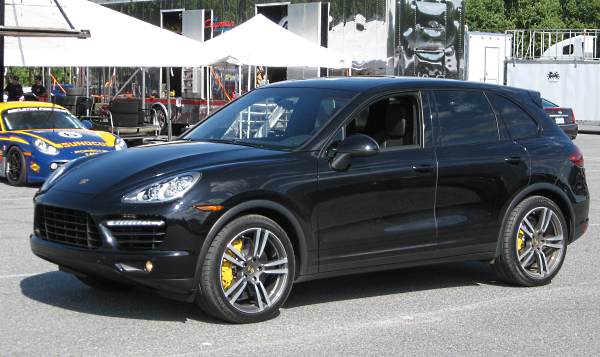
Porsche Cayenne - a thrill and a smile
You can no longer argue that Porsche is a slave to the concept of two-passenger sports cars. No siree. Porsche had purists rummaging through the medicine cabinet for their Prozac when it launched its Cayenne SUV in 2003. The release of the four-door Panamera last year had a similar impact. Just what is the world coming to?
Evidently the American public has recovered sufficiently from the shock to have purchased roughly 90,000 Cayennes over the years. This number will no doubt be significantly swelled with the launch of the second generation Cayenne as a 2011 this summer. It is about two inches longer, and slightly wider and taller than the previous model. It weighs about 400 pounds less. EPA-estimated fuel economy for all new versions haven't been announced at this writing; however if they follow those of the V8-equipped S that have been posted, fuel economy across the board will be impressively improved. There will even be a hybrid edition coming this fall that should, once again, throw purists into a tizzy.
When all of the dust settles, there will be four Cayenne models for 2011: Base, S, Turbo and the totally new S Hybrid. Each is defined by its power source: V6, V8, V8 turbo and gas-V8/electric motor, respectively. All four come standard with all-wheel drive. The $46,700 Base and $63,700 S enjoy a modest increase in power, while the $104,800 Turbo stays the same. However all three are quicker thanks to Porsche squeezing out excess weight wherever it could -- 86 pounds from the doors alone.
A breakdown of the specs reveals that a 300-horsepower 3.6-liter V6 powers the Base that uses a six-speed manual transmission to transfer output to the wheels. The eight-speed driver-shiftable automatic transmission that is standard in the more expensive Cayennes is an option for the Base. Generating 400 horsepower is the 4.8-liter V8 in the S. A turbocharged version of the same V8 in the Turbo produces 500 horsepower. Mating the V8 to an electric motor delivers a combined 380 horsepower in the $67,700 S Hybrid.
Porsche has posted 0-60 times for all four models. As you might guess, leading the pack is the Turbo with a time of 4.4 seconds; followed by the S at 5.6 seconds, the S Hybrid at 6.1 seconds, and the Base at 7.1 seconds with the manual and 7.4 seconds with the eight-speed automatic transmission. So far the only EPA estimated fuel economy numbers available are the 16 mpg in the city and 22 mpg on the highway for the S. Those are up from last year's figures of 13 mpg, city and 19 mpg highway. Porsche expects similar fuel savings for the Base and Turbo versions as well. An automatic start/stop function that turns off the engine at red lights and then automatically restarts it also contributes to the improved fuel numbers.
From behind the wheel, it's easy to forget you are in command of roughly two and a quarter tons -- two and a half tons in the S Hybrid. All versions handle brilliantly. Standard on the Turbo is an air suspension system with Porsche's Active Suspension Management (PASM) that provides active, infinite damper control on the front and rear axles. It has a choice of "Comfort," "Normal" and Sport settings. PASM is optional on the Base, S and S Hybrid models. Another bit of technology voodoo is the Porsche Torque Vectoring (PTV) optional system that uses variable torque distribution on the rear wheels to increase stability in the curves.
Despite being taller, the new Cayenne is sleeker in profile than the first generation SUV. Its front end, hood and lower fascia are also more in keeping with the rest of the Porsche lineup. The exterior changes are evolutionary in their execution, but the differences are apparent.
Styling changes dominate the interior; significantly more is changed than remains familiar. Whether it's the meatier, redesigned three-spoke steering wheel, the more sophisticated, raised center stack, or the simplified pod of gauges facing the driver, the look is dramatically different. There are still grab handles affixed to the center console, but their design has been carried to the door pulls. The seats still feature generous side bolsters and uncommon support. Split and folding, the rear seat reclines up to 6 degrees and offers 6.3 inches of fore-aft travel. Maximum cargo space is increased by 25 percent to 63 cubic feet with the backseat folded down.
A number of standard features are common to the entire Cayenne lineup. Full power accessories, leather seating, Bluetooth connectivity, multi-adjustable power front seats, tilt-telescoping steering wheel, and a Bose-infused 5.1 surround-sound system with CD player, USB port and auxiliary audio input jack are all included in the base price.
Although Porsche has raised prices for the redesigned Cayenne (Base is up $1,200 and the S $3,000), it is a larger, quicker, more fuel efficient SUV than its predecessor. And really, if you are going to spend $50,000 or more on an SUV, are you going to quibble over a grand or two? If you are prepared to spend the money, the 2011 Cayenne will reward you with a thrill and a smile every time you put the whip to it whether it's on the way to work, around the twisties or over uncharted terrain. It is indeed a Porsche and all that name represents.
by Russ Heaps - MyCarData
Evidently the American public has recovered sufficiently from the shock to have purchased roughly 90,000 Cayennes over the years. This number will no doubt be significantly swelled with the launch of the second generation Cayenne as a 2011 this summer. It is about two inches longer, and slightly wider and taller than the previous model. It weighs about 400 pounds less. EPA-estimated fuel economy for all new versions haven't been announced at this writing; however if they follow those of the V8-equipped S that have been posted, fuel economy across the board will be impressively improved. There will even be a hybrid edition coming this fall that should, once again, throw purists into a tizzy.
When all of the dust settles, there will be four Cayenne models for 2011: Base, S, Turbo and the totally new S Hybrid. Each is defined by its power source: V6, V8, V8 turbo and gas-V8/electric motor, respectively. All four come standard with all-wheel drive. The $46,700 Base and $63,700 S enjoy a modest increase in power, while the $104,800 Turbo stays the same. However all three are quicker thanks to Porsche squeezing out excess weight wherever it could -- 86 pounds from the doors alone.
A breakdown of the specs reveals that a 300-horsepower 3.6-liter V6 powers the Base that uses a six-speed manual transmission to transfer output to the wheels. The eight-speed driver-shiftable automatic transmission that is standard in the more expensive Cayennes is an option for the Base. Generating 400 horsepower is the 4.8-liter V8 in the S. A turbocharged version of the same V8 in the Turbo produces 500 horsepower. Mating the V8 to an electric motor delivers a combined 380 horsepower in the $67,700 S Hybrid.
Porsche has posted 0-60 times for all four models. As you might guess, leading the pack is the Turbo with a time of 4.4 seconds; followed by the S at 5.6 seconds, the S Hybrid at 6.1 seconds, and the Base at 7.1 seconds with the manual and 7.4 seconds with the eight-speed automatic transmission. So far the only EPA estimated fuel economy numbers available are the 16 mpg in the city and 22 mpg on the highway for the S. Those are up from last year's figures of 13 mpg, city and 19 mpg highway. Porsche expects similar fuel savings for the Base and Turbo versions as well. An automatic start/stop function that turns off the engine at red lights and then automatically restarts it also contributes to the improved fuel numbers.
From behind the wheel, it's easy to forget you are in command of roughly two and a quarter tons -- two and a half tons in the S Hybrid. All versions handle brilliantly. Standard on the Turbo is an air suspension system with Porsche's Active Suspension Management (PASM) that provides active, infinite damper control on the front and rear axles. It has a choice of "Comfort," "Normal" and Sport settings. PASM is optional on the Base, S and S Hybrid models. Another bit of technology voodoo is the Porsche Torque Vectoring (PTV) optional system that uses variable torque distribution on the rear wheels to increase stability in the curves.
Despite being taller, the new Cayenne is sleeker in profile than the first generation SUV. Its front end, hood and lower fascia are also more in keeping with the rest of the Porsche lineup. The exterior changes are evolutionary in their execution, but the differences are apparent.
Styling changes dominate the interior; significantly more is changed than remains familiar. Whether it's the meatier, redesigned three-spoke steering wheel, the more sophisticated, raised center stack, or the simplified pod of gauges facing the driver, the look is dramatically different. There are still grab handles affixed to the center console, but their design has been carried to the door pulls. The seats still feature generous side bolsters and uncommon support. Split and folding, the rear seat reclines up to 6 degrees and offers 6.3 inches of fore-aft travel. Maximum cargo space is increased by 25 percent to 63 cubic feet with the backseat folded down.
A number of standard features are common to the entire Cayenne lineup. Full power accessories, leather seating, Bluetooth connectivity, multi-adjustable power front seats, tilt-telescoping steering wheel, and a Bose-infused 5.1 surround-sound system with CD player, USB port and auxiliary audio input jack are all included in the base price.
Although Porsche has raised prices for the redesigned Cayenne (Base is up $1,200 and the S $3,000), it is a larger, quicker, more fuel efficient SUV than its predecessor. And really, if you are going to spend $50,000 or more on an SUV, are you going to quibble over a grand or two? If you are prepared to spend the money, the 2011 Cayenne will reward you with a thrill and a smile every time you put the whip to it whether it's on the way to work, around the twisties or over uncharted terrain. It is indeed a Porsche and all that name represents.
by Russ Heaps - MyCarData
Porsche 911 Turbo Cabriolet - money can buy happiness
In the human experience there’s nothing quite like the first time, for anything. And so it is with launching for the first time the 500-horsepower 2010 Porsche 911 Turbo outfitted with the lightning-fast dual-clutch seven-speed automatic transmission. It’s an experience that it is not soon forgotten. Call it g-force giddiness, akin to hitting the first big drop on a roller coaster.
The only driving skill required is to hold on to the wheel, keep your right foot planted to the floor, and keep your wits about you. No need to worry about modulating the clutch and gas to keep the vehicle in line while avoiding tire burnout. No need to be skilled at shifting from first to second at red line. Launch mode in the Porsche is initiated simply by putting the shifter into Drive. Wheel spin is nearly imperceptible at full-bore launch. There’s a split second as the twin turbo spools up and then you are slammed back into your seat. All four wheels bite into the concrete, the transmission snaps off ultra-fast shifts and 60 miles per hour arrives in around three seconds as you try to control your breathing. If you have a lot of empty asphalt in front of you, a quarter mile flashes past in around 11 seconds as speed nears 130 mph.
Even though the experience is not quite as sensational the second and third time around, the perceived need for speed in this Porsche is highly addictive; this in a sports car that is not only street legal but could very adequately serve as a daily driver. It will putter all day at 45 mph without complaint. It if asked it will drive all day at 100 mph without a whimper.
This automotive marvel comes courtesy of a rear-mounted twin-turbocharged 3.8-liter flat 6 that cranks out 500 horsepower and 480 pound-feet of torque, mated to the incredible Porsche dual-clutch gearbox and with standard all-wheel drive.
This Porsche has more than world-class straight-ahead performance. It has world-class driving dynamics as well. We found that the 911 turbo quickly trumped our eagerness to discover our limits behind the wheel when we reached speeds we’ve never before attempted on a couple of our favorite twisting road venues. And these are roads we have been using for nearly 20 years. The Porsche displayed its incredible prowess without the need to fully test the outer edges of our abilities in an expensive machine that we desired to return to its owner without crumpled fenders.
One of the most amazing aspects of the 911 was revealed to us simply sitting in the driveway. The interior is spacious for a sports car, ample room for a big guy. Supportive bucket seats with side bolsters that don’t cause pain on exiting are exemplary. Finding the correct driving position with the many seat settings together with a tilt, telescoping steering wheel is rewardingly easy.
And cargo capacity was amazingly large using the rear seats, which are amazingly small for a human being. Fold the seatbacks down and a nice-sized storage space opens up. Good thing, too, because the front-mounted trunk is no larger than an oversized glovebox.
You will pay thousands more for the soft top cabriolet, but if you’ve got the cash, it’s worth it. The top goes down – and up – in mere seconds with the push of a button. It’s stowed out of sight behind the seats.
The turbo version is the most expensive of the many 911 trim levels, and the turbo cabriolet trumps them all with a base price of $144,750. The steel top 911 turbo starts at $133,750. We emphasize “start” because the options list is 162 items long and many are sure to tempt. The extensive list points out the customization possibilities Porsche offers the buyer.
For the record, the base 911 begins at $78,750 and comes with a 3.6-liter “boxer” six producing 345 horsepower. Horsepower through the trim levels rises to 385, 435 and 450 before reaching the massive 500 horsepower provided by the turbo.
Our test car came in at an eye-popping pocketbook-draining $172,905. Among the more expensive goodies were the “Doppelkupplung” (Porsche speak for the dual-clutch-automatic transmission), $4,550; ceramic composite brakes, $8,840; and 19-inch Spyder wheels with center lock, $3,835.
In addition to a vast assortment of standard features including full leather trim, a 13-speaker Bose surround system, full power heated and cooled seats and automatic wipers, the turbo model also gets as standard aggressively tuned sport suspension and unique body styling. We were impressed with the build quality and the impeccably assembled interior.
The best all-around sports car we’ve ever driven? The answer is an emphatic Porsche 911 Turbo. No doubt, we’ll probably encounter something just a bit better at some point in the future. But for now, the combination of incredible drivability at any speed is unmatched in our experience.
This Porsche not only provides an exhilarating breath-taking experience, but it offers luxury commensurate with its price, and a rewarding driving experience whether commuting to work, taking a leisurely Sunday afternoon spin with the top down or rolling across uncharted roads at 110.
The 911 turbo proves money can buy motorized happiness.
By Jim Meachen and Ted Biederman - MyCarData
The only driving skill required is to hold on to the wheel, keep your right foot planted to the floor, and keep your wits about you. No need to worry about modulating the clutch and gas to keep the vehicle in line while avoiding tire burnout. No need to be skilled at shifting from first to second at red line. Launch mode in the Porsche is initiated simply by putting the shifter into Drive. Wheel spin is nearly imperceptible at full-bore launch. There’s a split second as the twin turbo spools up and then you are slammed back into your seat. All four wheels bite into the concrete, the transmission snaps off ultra-fast shifts and 60 miles per hour arrives in around three seconds as you try to control your breathing. If you have a lot of empty asphalt in front of you, a quarter mile flashes past in around 11 seconds as speed nears 130 mph.
Even though the experience is not quite as sensational the second and third time around, the perceived need for speed in this Porsche is highly addictive; this in a sports car that is not only street legal but could very adequately serve as a daily driver. It will putter all day at 45 mph without complaint. It if asked it will drive all day at 100 mph without a whimper.
This automotive marvel comes courtesy of a rear-mounted twin-turbocharged 3.8-liter flat 6 that cranks out 500 horsepower and 480 pound-feet of torque, mated to the incredible Porsche dual-clutch gearbox and with standard all-wheel drive.
This Porsche has more than world-class straight-ahead performance. It has world-class driving dynamics as well. We found that the 911 turbo quickly trumped our eagerness to discover our limits behind the wheel when we reached speeds we’ve never before attempted on a couple of our favorite twisting road venues. And these are roads we have been using for nearly 20 years. The Porsche displayed its incredible prowess without the need to fully test the outer edges of our abilities in an expensive machine that we desired to return to its owner without crumpled fenders.
One of the most amazing aspects of the 911 was revealed to us simply sitting in the driveway. The interior is spacious for a sports car, ample room for a big guy. Supportive bucket seats with side bolsters that don’t cause pain on exiting are exemplary. Finding the correct driving position with the many seat settings together with a tilt, telescoping steering wheel is rewardingly easy.
And cargo capacity was amazingly large using the rear seats, which are amazingly small for a human being. Fold the seatbacks down and a nice-sized storage space opens up. Good thing, too, because the front-mounted trunk is no larger than an oversized glovebox.
You will pay thousands more for the soft top cabriolet, but if you’ve got the cash, it’s worth it. The top goes down – and up – in mere seconds with the push of a button. It’s stowed out of sight behind the seats.
The turbo version is the most expensive of the many 911 trim levels, and the turbo cabriolet trumps them all with a base price of $144,750. The steel top 911 turbo starts at $133,750. We emphasize “start” because the options list is 162 items long and many are sure to tempt. The extensive list points out the customization possibilities Porsche offers the buyer.
For the record, the base 911 begins at $78,750 and comes with a 3.6-liter “boxer” six producing 345 horsepower. Horsepower through the trim levels rises to 385, 435 and 450 before reaching the massive 500 horsepower provided by the turbo.
Our test car came in at an eye-popping pocketbook-draining $172,905. Among the more expensive goodies were the “Doppelkupplung” (Porsche speak for the dual-clutch-automatic transmission), $4,550; ceramic composite brakes, $8,840; and 19-inch Spyder wheels with center lock, $3,835.
In addition to a vast assortment of standard features including full leather trim, a 13-speaker Bose surround system, full power heated and cooled seats and automatic wipers, the turbo model also gets as standard aggressively tuned sport suspension and unique body styling. We were impressed with the build quality and the impeccably assembled interior.
The best all-around sports car we’ve ever driven? The answer is an emphatic Porsche 911 Turbo. No doubt, we’ll probably encounter something just a bit better at some point in the future. But for now, the combination of incredible drivability at any speed is unmatched in our experience.
This Porsche not only provides an exhilarating breath-taking experience, but it offers luxury commensurate with its price, and a rewarding driving experience whether commuting to work, taking a leisurely Sunday afternoon spin with the top down or rolling across uncharted roads at 110.
The 911 turbo proves money can buy motorized happiness.
By Jim Meachen and Ted Biederman - MyCarData
Porsche 997 Turbo com Rodas "21" by VRT
[DUB]Cayenne nas "23"
Cayenne é um abuso de autoridade
SUV esbanja tecnologia e conforto para honrar requinte e arrojo da Porsche
Quando a Porsche lançou o Cayenne, em 2002, os conservadores de plantão torceram o nariz. Afinal, era inadmissível uma marca puramente esportiva lançar um SUV grandalhão. Mas, no caso da fabricante alemã, os fins acabariam por justificar os meios. Foi graças às boas vendas do jipão juntamente com o sucesso comercial do Boxster que a Porsche voltou a dar lucros e saiu do vermelho.
Para os mais apocalípticos, inclusive, teria livrado a fabricante da falência. O fato é que o Cayenne, a despeito da desaprovação dos tradicionalistas, mostrou ao que veio e se tornou uma referência no seleto segmento de utilitários esportivos premium. E com a filosofia inerente neste nicho: muito conforto, vasto aparato tecnológico e motores potentes para justificar a nobre linhagem.
A versão S do Cayenne já mostra seus dotes e estas tradições no conjunto mecânico. A configuração intermediária é equipada com um motor V8 em alumínio, com 4.8 litros, injeção direta de combustível, comando variável de válvulas na admissão e no escape, potência de 400 cv a 6.500 rpm e torque máximo de 54 kgfm a 3.500 giros. O propulsor possui função start/stop que o desliga assim que o veículo para, religando-o no momento em que o pedal do acelerador é acionado e trabalha com tração integral nas quatro rodas e com o câmbio automático Tiptronic, com oito velocidades.
O sistema de tração do utilitário esportivo é chamado de PTM Porsche Traction Management. Por meio de um botão no console central, é possível ajustar o funcionamento do 4X4 em três diferentes níveis. O "Offroad 1" aumenta a tração das rodas, aciona o sistema de ABS de freios e controla a velocidade do Cayenne em descidas. O nível 2 é indicado para terrenos mais acidentados e menos aderentes. Neste caso, o dispositivo aciona o bloqueio transversal do eixo dianteiro. Já o "Offroad 3" funciona como uma espécie de reduzida, com o diferencial traseiro totalmente bloqueado.
A tração do Cayenne S trabalha em conjunto com uma parafernália tecnológica bastante interessante. Entre elas, a suspensão pneumática, que ajusta a altura dos amortecedores em até seis opções. Desta forma, o SUV da Porsche pode ficar até 5,8 cm mais alto, com uma distância de 26,8 cm do solo, ideal para condições fora de estrada mais exigentes e até uma velocidade de 30 km/h. No outro extremo, o Cayenne pode ser rebaixado 5,2 cm do seu nível "normal", com uma altura em relação ao chão de 15,8 cm, mais adequada às pistas niveladas. Esse conjunto ainda conta com o PASM Porsche Active Suspension Management , que controla eletronicamente a pressão dos amortecedores, deixando-os mais firmes na opção "Sport".
Ao mesmo tempo, o Cayenne S vem com o que se espera de um Porsche, mesmo que um jipão, com preços iniciais de R$ 379 mil. Controles eletrônicos de estabilidade e de tração, seis airbags, sensor de luminosidade, Auto Hold que impede que o veículo ande para trás em trechos inclinados , controle de cruzeiro, computador de bordo, sistema de som com tela touch screen de 7 polegadas, Bluetooth e GPS, sensores de obstáculos com câmara de ré, bancos elétricos, ar automático, entre outros. O "Pacote Brasil" para a versão inclui som Bose, rodas aro 21, sensor de ponto cego, faróis bixênon direcionais e porta-malas automático.
Mesmo assim, o pacote de opcionais é vasto. Controle de cruzeiro adaptativo que monitora os veículos à frente e desacelera e acelera o carro conforme a mudança do tráfego , sistema de entretenimento traseiro com duas telas e fones de ouvido sem fio, comando de voz, airbags laterais traseiros, Porsche Entry & Drive que dispensa o uso das chaves para abrir e ligar o carro , discos de cerâmica nos freios, teto solar e ar quadrizone são alguns dos "mimos" para tentar agradar a clientela. Todos eles podem ser encomendados "de fábrica", o que pode fazer o Cayenne S ultrapassar os R$ 500 mil. A tradição, afinal, deve ser honrada em todas as esferas.
Instantâneas
# O Porsche Cayenne é produzido em Leipzig, na Alemanha, onde compartilha plataforma com o Volkswagen Touareg e com o Audi Q7 as três marcas fazem parte do Grupo Volkswagen.
# A segunda geração do SUV foi revelada no Salão de Genebra de 2010.
# No Brasil, o utilitário esportivo é vendido também na sua versão básica com motor 3.6 V6 de 300 cv e na top Turbo, com o mesmo 4.8 V8 do Cayenne S, só que com 500 cv de potência.
# Mesmo com a opção esportiva do PASM selecionada, o dispositivo é capaz de detectar se as condições do piso pioraram e ajustar os amortecedores de volta à calibragem convencional.
# No ano passado, a linha Cayenne teve 514 unidades vendidas no Brasil, segundo dados da Fenabrave.
# A Porsche pode trazer ainda este ano a versão híbrida do SUV, chamada Cayenne S Hybrid, com um V6 de 333 cv em conjunto com um motor elétrico de 47 cv.
Ponto a ponto
Desempenho – Transportar mais de duas toneladas não é tarefa para qualquer veículo, mas o V8 do Cayenne S dá conta do recado. É verdade que as primeiras respostas ao acelerador são um pouco tímidas parece que há um pequeno delay, talvez por conta do start/stop. Mas essa sensação passa logo e o utilitário esportivo engrena e mostra a voracidade dos seus 400 cv, com acelerações instigantes para um veículo deste porte e retomadas vitaminadas graças ao torque de 54 kgfm entregue já quase totalmente aos 3 mil giros. O câmbio Tiptronic bem escalonado corrobora para uma performance exemplar, com mudanças de velocidade ágeis e sem delays. Segundo a Porsche, o zero a 100 km/h é feito em 5,9 segundos e a máxima é de 258 km/h. Nota 8.
Estabilidade – Com uma excelente rigidez torcional, o Cayenne prova que é bem construído. O modelo torce o mínimo da carroceria nas curvas em alta velocidade e não faz qualquer menção de desgarrar, mesmo quando o motorista abusa. Méritos também não só dos controles de estabilidade, mas também do sistema de suspensão pneumática que, quase instantaneamente, compensa as variações da carroceria e minimiza essas oscilações. Nas frenagens bruscas, o Cayenne também se mostrou na mão do condutor e nas retas a comunicação entre rodas e volante se mantém perfeita mesmo a velocidades acima dos 130 km/h. Nota 10.
Interatividade – A versão do Cayenne S testada veio bem fornida com sistema de entretenimento com tela touch screen e ajustes elétricos do banco e do volante, o que otimiza a ergonomia e simplifica a vida do motorista. A maioria dos comandos é bem posicionada e intuitiva, só que os comandos elétricos do assento requerem mãos espremidas entre o banco e a porta. A visibilidade traseira é comprometida pelas largas colunas e pela altura do SUV, mas na hora de estacionar é possível contar com a câmara de ré. A direção hidráulica servo assistida, bastante macia com o carro parado ou em baixas velocidades, facilita na hora de manobrar, ao mesmo tempo em que privilegia a esportividade em altas velocidades, com uma pegada mais firme. Nota 9.
Consumo – O modelo testado anotou a média de 6,2 km/l em percurso majoritariamente plano e livre, sem muitos engarrafamentos. Nota 6.
Tecnologia – Como em toda marca premium, o Porsche Cayenne S reúne uma vasta lista de itens modernos e interessantes, como suspensão pneumática, ajuste de altura automático do veículo, motor em alumínio com injeção direta e função start/stop, controles de estabilidade e de tração, sensor de ponto cego, faróis bixênon autodirecionais, sistema de som de alta definição Bose, entre outros. Além disso, conta com uma plataforma que foi modernizada no ano passado e uma lista de opcionais com itens igualmente interessantes e avançados, como controle de cruzeiro adaptativo, freios com discos de cerâmica e sistema de entretenimento traseiro. Nota 10.
Conforto – Há um generoso espaço para pernas e cabeças de todos os ocupantes e atrás três adultos conseguem viajar sem apertos. Os bancos parecem abraçar o motorista e o passageiro e ainda dispõem de ajustes elétricos. O isolamento acústico é eficiente mesmo a 130 km/h, mas o destaque vai mesmo para o sistema de suspensão dinâmica pneumática, que calibra automaticamente os amortecedores de acordo com as condições do piso, sem refletir qualquer irregularidade para o habitáculo. Nota 10.
Habitabilidade – Entrar em um SUV exige sempre certo esforço, mas nada absurdo no Cayenne. Além disso, as generosas portas oferecem um vasto vão para os acessos e o porta-malas acomoda bons 670 litros, sendo que ainda há um botão que fecha e abre automaticamente a tampa traseira. Nota 8.
Acabamento – Painéis revestidos com primor e materiais de qualidade esbanjam sofisticação e agradam ao tato e aos olhos. Há ainda detalhes cromados e o revestimento em couro de alta qualidade entrega o requinte que um Porsche pede. Nota 9.
Design – É o ponto mais controverso do Cayenne. O jeito abrutalhado com os faróis angulosos e o capô abaulado fazem com que o SUV tenha um estilo que está muito longe de ser uma unanimidade. Apesar da inegável evolução em relação à desarmônica primeira versão. Nota 7.
Custo/benefício – Os R$ 379 mil pedidos pela versão S do utilitário da Porsche pagam não só aparato tecnológico e o conforto, mas muito mais o status e a imponência de um veículo de uma marca premium. O segmento também oferece opções distintas. Entre os rivais de marcas de luxo no mercado brasileiro, o BMW X5 4.8 parte dos R$ 341.300 e o Mercedes-Benz ML só vem ou em versões diesel R$ 308.500 na 350 CDI Sport ou preparada 63 AMG R$ 420 mil. Já o seu parceiro de plataforma, o Audi Q7, é vendido no Brasil na configuração com motor turbo 3.0 TFSI e por R$ 320 mil. Nota 5.
Total – O Cayenne S somou 82 pontos em 100 possíveis.
Impressões ao dirigir
Tamanho é documento
Dirigir um utilitário esportivo em uma cidade grande e esburacada é sempre uma tarefa interessante. Ainda mais quando o veículo em questão é um Porsche, marca tradicionalmente associada a veículos esportivos e leves. Mas quem sabe a lição nunca esquece, e a marca alemã tratou de colocar um motor bastante competente para mover os mais de 2 mil kg do Cayenne S. O 4.8 V8 e seus 400 cv dão mais do que conta do recado. Ao pisar no pedal do acelerador o giro sobe com vontade e, não fosse um pequeno delay inicial, o SUV germânico sairia arrancando quase que imediatamente.
As vigorosas acelerações empurram o corpo dos ocupantes contra o banco e as ágeis mudanças de marcha da caixa automática Tiptronic fazem o Cayenne praticamente voar. Tanto que o zero a 100 km/h prometido pela Porsche é de 5,9 segundos, nada mal para um SUV grandalhão. Nas retomadas de velocidade, mais eficiência do propulsor. Os 54 kgfm enchem o motor já nas 3 mil rpm, o que facilita na hora das ultrapassagens.
Facilidade a bordo, aliás, é o que o condutor mais tem dentro de um Cayenne. A boa vida é garantida pelos amplos bancos e pelos infinitos equipamentos de entretenimento, além da ergonomia eficiente, do sensor de ponto cego e da câmara de vídeo para a hora de manobrar de ré. Isso sem falar nos dispositivos eletrônicos que aprimoram o prazer de dirigir, como a direção que em velocidades altas tem uma rigidez mais firme, e o excelente jogo de suspensão pneumática, que calibra automaticamente os amortecedores de acordo com o tipo de piso e as oscilações da carroceria.
Na estabilidade, nada de sustos também. Mesmo em velocidades altas e curvas mais sinuosas e fechadas, o utilitário esportivo comprova seu equilíbrio, sem fazer qualquer menção de rolar a carroceria. Um comportamento garantido por um chassi bem construído, com uma ótima rigidez torcional e a ajudinha sempre bem-vinda dos dispositivos eletrônicos de estabilidade e de tração. Uma estrutura que é quase obrigatória para uma fábrica de automóveis que se enquadra no seleto grupo de marcas premium.
Porsche Cayenne Turbo - the Porsche of SUV's
We launched out the pit lane at the Savannah Harbor race course as rain began to spit from the languid Southern sky.
The 500-hp Porsche Cayenne Turbo’s V-8 bellowed melodically as Hurley Haywood pointed it deep into the apex of Turn One on Grand Prize of America Avenue, the 2.1-mile Savannah/Hilton Head Speed Classic track.
Light rain streamed off the glass as the second-generation of the Porsche SUV tackled each turn flat and feisty as we hit about 110-mph on the back straight.
“It wears the badge of Porsche and anything that is named a Porsche will handle well on a race track,” said Haywood, 5-time Rolex 24 champion, with a few other 24-hour race wins thrown in, Porsche his mainstay.
“It is all new, 400 pounds lighter than its predecessor, and it has all sorts of electronic gadgetry that makes it really nimble on a race track,” he said as he drove. “It has Dynamic Chassis Control. It is really brilliant the way this thing is able to negotiate a race track, yet still be absolutely calm on the road.”
They say love is better the second time around. The same may be true for the new Cayenne, as marshals pointed us in as rain fell.
* Cayenne in camera – The first Cayenne was birthed off the platform shared by the VW Toureg and Audi Q7 SUVs, and the second generation shares them as well for 2011. There’s a V-6, a naturally-aspirated V-8 Cayenne S and Cayenne GTS, our turbocharged Cayenne Turbo and a 550-hp Cayenne Turbo S. A Cayenne S Transsyberia and limited edition Cayenne GTS Porsche Design Edition 3 join a hybrid gas-electric version. All got a major facelift to bring more 911 sleekness to the shape, 1.9 inches longer than its predecessor, with a 1.6-inch wheelbase stretch and an inch less height.
As a veteran Porsche racer and driving instructor, Haywood has piloted many a Cayenne since they were introduced to unbelieving Porschefiles in 2002 – the legendary sports car maker designing a 5-passenger sports utility vehicle it claimed was as good on road as off. Now Porsche has entirely revamped its volume leader, a quarter million sold as of February 2009, the most mainstream of its vehicles behind the new 4-door Panamera. Longer, lighter and more powerful, it looks more like an all-in-one design.
“It was Porsche’s biggest seller of all the model lines, so the Cayenne is extremely good for Porsche and people have gotten used to the concept of a Cayenne and its window of performance has gone up considerably,” Haywood said. “It is the same thing we saw when we heard they were going to make a sedan. Who would have dreamt Porsche would be in the sedan business. But all the skeptics were proved instantly wrong when they saw the Panamera. The car is sensational. I drive one.”
The biggest change from the 2010 model is a wider, lower crosshatch grill on a longer, sharper nose. The teardrop headlights are slimmer, closer to the stronger-looking fender’s outer edges. Slimmer side intakes flanking the more aggressive center grill house strips of LED running lights over inset fog lamps. It doesn’t look as blunt anymore, more streamlined.
Matte black plastic frames more muscular fender flares and 21-inch Michelin rubber on beautiful gray metallic and silver 10-spoke wheels showing huge drilled ceramic composite brakes with distinctive yellow calipers. The lower roofline adds to the wide, hunkered-down look. There are more curves and muscle in its side shape, with a long roof spoiler and a more raked rear hatch flanked by aggressive LED taillights. Quad steel tailpipes stick out of the lower fascia, flanking a trailer hitch. It all shares design DNA with the Panamera.
Parked in the Savannah track paddock near some 911 race cars and Cayman racers, our black Cayenne Turbo garnered folks eager to look at and under it, and got lots of admiring glances on the interstate too.
*Cayenne cabin – What I loved about the new Panamera’s interior has been installed mostly intact into the second-gen Cayenne. Swathed in stitched leather with an Alcantara suede headliner and alloy accents, our Turbo has a more sculpted look to the dashboard, with a higher-mounted Porsche Communication Management screen. The unit’s shape flows into the center dashtop vents. Below, a wide, high center console that rises to meet the dashboard center stack, with neatly grouped controls up for dual-zone climate controls and displays, heated and cooled front seats and vent position. At the aft end of the console, flanked by sturdy V-shaped grab handles, controls to adjust the suspension from comfort to normal to sport, raise and lower the air springs, and four-wheel-drive terrain management settings from street to mountain. A separate transmission setting selects between Normal and Sport modes, the latter deepening the V-8 growl as it makes the throttle more responsive and makes shift points more aggressive.
There is a full compliment of gauges, with a big central 8,000-rpm tach with digital speedometer and gear position indicator, flanked on the left by a 190-mph speedometer overlapping a engine oil and temperature gauges. To the right, a color LCD trip computer screen shows off a navigation map or turn-by-turn directions plus a turbo boost gauge, overlapping fuel and coolant temperature gauges. A sporty three-spoke alloy steering wheel with fat leather-clad rim and power tilt/telescope has two long paddle shifters behind. There are no auxiliary controls for stereo or Bluetooth in this Porsche - the steering wheel is for steering. The navigation system has a 40 GB hard drive, with touch-screen operation of it, stereo, XM traffic, hands-free telephone and superb Bergmeister AM-FM-XM Satellite-CD sound system. The MP3 audio and USB hookup are in the small center armrest storage area with a 12-volt outlet.
The black leather sports bucket seats are superbly comfortable and firmly supportive, with 14-way power adjustments including height-adjustable power lumbar and bottom and side bolsters and dual memory. The bolsters do intrude in exit and entry. Overhead, white LED spotlights and a glowing U-shaped courtesy light frame HomeLink, sonar parking assist and moonroof controls. The glove box is deep, and there are twin gripping cup holders. And let’s not forget the real alloy-faced pedals. With the increase in wheelbase, the back seats have a lot of leg as well as head room for two, even three adults in a pinch. The seat backs recline a bit, and slide fore-and-aft by 6.3 inches. Under the power tailgate, a nice amount of storage room with steel tie-downs and a small cargo nook with net on one side. The rear seats split 40/20/40, only a more raked rear window intruding on some big box cargo capacity.
“They have made the interior a lot like the Panamera, so it is really beautiful on the inside,” said Haywood, VP of Brumos Porsche. “We are selling them as fast as we can get them so it’s a real hit.”
Again, fit and finish was superb inside, while switchgear feel was precise. The Cayenne is quiet at highway speed except for a slight whistle from the driver’s side window rubber, and we appreciated cornering lights outside and white-lit buttons inside at night.
* Cayenne combustability – This Porsche gets anywhere from 300 to 550-hp, with a 380-hp hybrid coming soon. Like any good SUV, Porsche claims decent towing ability - up to 7,716 lbs. In our case, there’s a very healthy 4.8-liter, 500-hp twin-turbo V-8 with a prodigious 516 lb-ft of torque, hooked to a responsive 8-speed Tiptronic S transmission that can be left in “D,” paddle shifted, or just shifted via the gear shift. Letting our 2,800-mile-old tester rip with transmission and suspension set in “Sport,” and 60-mph comes up in 4.9 seconds, and 100-mph in 10.6 seconds, the boost gauge reading up to .7 bar, the quad exhaust emitting a melodious bellow. Thanks to an auto-stop feature that kills the engine at stop lights, plus weight reduction, the Turbo gets better mileage, averaging 20-mpg on our trip, but down to 9-mpg in track use on premium.
The Turbo’s air suspension system has comfort, normal and sport settings, plus a new active all-wheel drive system with stability control. Under normal conditions, drive is biased to the rear wheels. But an electronically-controlled multi-plate clutch sends it forward if needed when you get in deep, or over a hill. A new torque vectoring system can vary power to the rear wheels to help as well, even slowing down the inside rear wheel to help in a turn. On the race track, the Cayenne clipped apexes like a sports car, a bit of bobble over rumble strips the only indication that it’s a bit higher than a Panamera or 911. A tunnel bump in the back straight didn’t upset it.
“It’s the kind of car you can do that in, then take the kids and pick up the groceries at the store and the take the kids to school,” Haywood said as we rolled into the track’s paddock. “They have done a phenomenal job on this car.”
The ride in “Comfort” setting was soft but not mushy, bumps in old Savannah handled well. “Normal” adjusts as needed to road surfaces and did so quickly, while “Sport” was a very firm, but again handled rebound smoothly. Toss it into a turn and the all-wheel-drive just routes power where needed for an all-hands-on-deck grip. The Cayenne didn’t show much body roll thanks to a tightly controlled independent double wishbone front/multi-link rear suspension, Play very hard and there’s understeer, but you can let the rear tires out to play quite controllably accompanied by superb steering feel, even with stability control off. On the race track, the Cayenne just acted like a tall Porsche car, with superb throttle control.
As good as the Cayenne is on road and track, it can go off road quite well. Our Turbo had summer performance tires. But in sand and rutted dirt, the ride was comfortable and controlled and traction great in “mountain” setting. There’s low range gearing via the center console switch clicked to the off-road position, which also lifts the Cayenne from 8.46 inches of ground clearance to 10.67 inches. Standing starts up 45-degree sandy hills saw no slip, the nose, tail and center never bottoming out. And with a hill descent feature that taps brakes to “walk” us down hills, the Cayenne was in control. Then literally seconds later, suspension hunkered down and shocks set to “Sport,” we were ripping through our autocross course with aplomb. The power steering was precise and made it easy to place what is still a heavy (4,784-lb.) vehicle. The 15.35-inch front/14.09-inch rear cross-drilled vented ceramic brakes were fade-resistant all the time, with short and precise pedal feel and great stopping power time after time with no fade. We had slight squeak when braking a few times.
* Porsche price – A base V-6 Cayenne starts under $50,000. But take it on up to the Turbo and base price is $104,800, albeit with standards like a 500-hp twin-turbo V-8, 8-speeed automatic with auto-engine stop, air suspension, moonroof, cruise control, leather seats, 19-inch alloy wheels, Bose sound system and four-wheel-drive. Options speed up the price as quickly as that engine does: $3,965 for the 21-inch wheels and wheel arch extensions; $8,840 for the ceramic brakes, $3,500 for the sport package (body-color trim, roof spoiler and quad pipes); $3,990 Burmeister sound system; and $800 cooled front seats. Add a few more goodies and our very comfortable, capable and fast Cayenne was $128,610. Competition like the Audi Q7 or BMW X5 can’t match the Cayenne Turbo’s power or athleticism on road or off, although the Bimmer comes closest in its V-8 form. Both do cost less.
* Bottom line – The new Porsche Cayenne excels at everything now, being lighter, better handling and sportier looking. It is expensive in the Turbo version, but I saw how well the base V-8 version did at Savannah (with Haywood at the wheel), so there are options. And snob appeal aside,
it is a Porsche.
2011 Porsche Cayenne Turbo Specifications:
Vehicle type - 4-door, 5-passenger sport-utility vehicle
Base price - $104,800 (As driven - $128,610)
Engine type - Twin turbocharged, quad overhead cam, 32-valve, Variocam aluminum V-8
Displacement - 4.8-liters
Horsepower (net) - 500 hp at 6,000 rpm
Torque (lb-ft) - 516 at 2,250 – 4,500 rpm
Transmission - 8-speed Tiptronic S automatic
Wheelbase - 114 in.
Overall length – 190.8 in.
Overall width – 76.3 in.
Height - 67 in.
Front headroom – 38.6 in.
Front legroom – 40.6 in.
Rear headroom – n/a.
Rear legroom – n/a
Cargo capacity – 23.7 cubic feet/60.2 w/rear seat folded
Towing capacity - up to 7,716 lbs. w/trailer hitch
Curb weight – 4,784 pounds
Fuel capacity - 26.4 gallons
Mileage rating - 15 mpg city/22 mpg highway
Last word – The Porsche of SUVs
The 500-hp Porsche Cayenne Turbo’s V-8 bellowed melodically as Hurley Haywood pointed it deep into the apex of Turn One on Grand Prize of America Avenue, the 2.1-mile Savannah/Hilton Head Speed Classic track.
Light rain streamed off the glass as the second-generation of the Porsche SUV tackled each turn flat and feisty as we hit about 110-mph on the back straight.
“It wears the badge of Porsche and anything that is named a Porsche will handle well on a race track,” said Haywood, 5-time Rolex 24 champion, with a few other 24-hour race wins thrown in, Porsche his mainstay.
“It is all new, 400 pounds lighter than its predecessor, and it has all sorts of electronic gadgetry that makes it really nimble on a race track,” he said as he drove. “It has Dynamic Chassis Control. It is really brilliant the way this thing is able to negotiate a race track, yet still be absolutely calm on the road.”
They say love is better the second time around. The same may be true for the new Cayenne, as marshals pointed us in as rain fell.
* Cayenne in camera – The first Cayenne was birthed off the platform shared by the VW Toureg and Audi Q7 SUVs, and the second generation shares them as well for 2011. There’s a V-6, a naturally-aspirated V-8 Cayenne S and Cayenne GTS, our turbocharged Cayenne Turbo and a 550-hp Cayenne Turbo S. A Cayenne S Transsyberia and limited edition Cayenne GTS Porsche Design Edition 3 join a hybrid gas-electric version. All got a major facelift to bring more 911 sleekness to the shape, 1.9 inches longer than its predecessor, with a 1.6-inch wheelbase stretch and an inch less height.
As a veteran Porsche racer and driving instructor, Haywood has piloted many a Cayenne since they were introduced to unbelieving Porschefiles in 2002 – the legendary sports car maker designing a 5-passenger sports utility vehicle it claimed was as good on road as off. Now Porsche has entirely revamped its volume leader, a quarter million sold as of February 2009, the most mainstream of its vehicles behind the new 4-door Panamera. Longer, lighter and more powerful, it looks more like an all-in-one design.
“It was Porsche’s biggest seller of all the model lines, so the Cayenne is extremely good for Porsche and people have gotten used to the concept of a Cayenne and its window of performance has gone up considerably,” Haywood said. “It is the same thing we saw when we heard they were going to make a sedan. Who would have dreamt Porsche would be in the sedan business. But all the skeptics were proved instantly wrong when they saw the Panamera. The car is sensational. I drive one.”
The biggest change from the 2010 model is a wider, lower crosshatch grill on a longer, sharper nose. The teardrop headlights are slimmer, closer to the stronger-looking fender’s outer edges. Slimmer side intakes flanking the more aggressive center grill house strips of LED running lights over inset fog lamps. It doesn’t look as blunt anymore, more streamlined.
Matte black plastic frames more muscular fender flares and 21-inch Michelin rubber on beautiful gray metallic and silver 10-spoke wheels showing huge drilled ceramic composite brakes with distinctive yellow calipers. The lower roofline adds to the wide, hunkered-down look. There are more curves and muscle in its side shape, with a long roof spoiler and a more raked rear hatch flanked by aggressive LED taillights. Quad steel tailpipes stick out of the lower fascia, flanking a trailer hitch. It all shares design DNA with the Panamera.
Parked in the Savannah track paddock near some 911 race cars and Cayman racers, our black Cayenne Turbo garnered folks eager to look at and under it, and got lots of admiring glances on the interstate too.
*Cayenne cabin – What I loved about the new Panamera’s interior has been installed mostly intact into the second-gen Cayenne. Swathed in stitched leather with an Alcantara suede headliner and alloy accents, our Turbo has a more sculpted look to the dashboard, with a higher-mounted Porsche Communication Management screen. The unit’s shape flows into the center dashtop vents. Below, a wide, high center console that rises to meet the dashboard center stack, with neatly grouped controls up for dual-zone climate controls and displays, heated and cooled front seats and vent position. At the aft end of the console, flanked by sturdy V-shaped grab handles, controls to adjust the suspension from comfort to normal to sport, raise and lower the air springs, and four-wheel-drive terrain management settings from street to mountain. A separate transmission setting selects between Normal and Sport modes, the latter deepening the V-8 growl as it makes the throttle more responsive and makes shift points more aggressive.
There is a full compliment of gauges, with a big central 8,000-rpm tach with digital speedometer and gear position indicator, flanked on the left by a 190-mph speedometer overlapping a engine oil and temperature gauges. To the right, a color LCD trip computer screen shows off a navigation map or turn-by-turn directions plus a turbo boost gauge, overlapping fuel and coolant temperature gauges. A sporty three-spoke alloy steering wheel with fat leather-clad rim and power tilt/telescope has two long paddle shifters behind. There are no auxiliary controls for stereo or Bluetooth in this Porsche - the steering wheel is for steering. The navigation system has a 40 GB hard drive, with touch-screen operation of it, stereo, XM traffic, hands-free telephone and superb Bergmeister AM-FM-XM Satellite-CD sound system. The MP3 audio and USB hookup are in the small center armrest storage area with a 12-volt outlet.
The black leather sports bucket seats are superbly comfortable and firmly supportive, with 14-way power adjustments including height-adjustable power lumbar and bottom and side bolsters and dual memory. The bolsters do intrude in exit and entry. Overhead, white LED spotlights and a glowing U-shaped courtesy light frame HomeLink, sonar parking assist and moonroof controls. The glove box is deep, and there are twin gripping cup holders. And let’s not forget the real alloy-faced pedals. With the increase in wheelbase, the back seats have a lot of leg as well as head room for two, even three adults in a pinch. The seat backs recline a bit, and slide fore-and-aft by 6.3 inches. Under the power tailgate, a nice amount of storage room with steel tie-downs and a small cargo nook with net on one side. The rear seats split 40/20/40, only a more raked rear window intruding on some big box cargo capacity.
“They have made the interior a lot like the Panamera, so it is really beautiful on the inside,” said Haywood, VP of Brumos Porsche. “We are selling them as fast as we can get them so it’s a real hit.”
Again, fit and finish was superb inside, while switchgear feel was precise. The Cayenne is quiet at highway speed except for a slight whistle from the driver’s side window rubber, and we appreciated cornering lights outside and white-lit buttons inside at night.
* Cayenne combustability – This Porsche gets anywhere from 300 to 550-hp, with a 380-hp hybrid coming soon. Like any good SUV, Porsche claims decent towing ability - up to 7,716 lbs. In our case, there’s a very healthy 4.8-liter, 500-hp twin-turbo V-8 with a prodigious 516 lb-ft of torque, hooked to a responsive 8-speed Tiptronic S transmission that can be left in “D,” paddle shifted, or just shifted via the gear shift. Letting our 2,800-mile-old tester rip with transmission and suspension set in “Sport,” and 60-mph comes up in 4.9 seconds, and 100-mph in 10.6 seconds, the boost gauge reading up to .7 bar, the quad exhaust emitting a melodious bellow. Thanks to an auto-stop feature that kills the engine at stop lights, plus weight reduction, the Turbo gets better mileage, averaging 20-mpg on our trip, but down to 9-mpg in track use on premium.
The Turbo’s air suspension system has comfort, normal and sport settings, plus a new active all-wheel drive system with stability control. Under normal conditions, drive is biased to the rear wheels. But an electronically-controlled multi-plate clutch sends it forward if needed when you get in deep, or over a hill. A new torque vectoring system can vary power to the rear wheels to help as well, even slowing down the inside rear wheel to help in a turn. On the race track, the Cayenne clipped apexes like a sports car, a bit of bobble over rumble strips the only indication that it’s a bit higher than a Panamera or 911. A tunnel bump in the back straight didn’t upset it.
“It’s the kind of car you can do that in, then take the kids and pick up the groceries at the store and the take the kids to school,” Haywood said as we rolled into the track’s paddock. “They have done a phenomenal job on this car.”
The ride in “Comfort” setting was soft but not mushy, bumps in old Savannah handled well. “Normal” adjusts as needed to road surfaces and did so quickly, while “Sport” was a very firm, but again handled rebound smoothly. Toss it into a turn and the all-wheel-drive just routes power where needed for an all-hands-on-deck grip. The Cayenne didn’t show much body roll thanks to a tightly controlled independent double wishbone front/multi-link rear suspension, Play very hard and there’s understeer, but you can let the rear tires out to play quite controllably accompanied by superb steering feel, even with stability control off. On the race track, the Cayenne just acted like a tall Porsche car, with superb throttle control.
As good as the Cayenne is on road and track, it can go off road quite well. Our Turbo had summer performance tires. But in sand and rutted dirt, the ride was comfortable and controlled and traction great in “mountain” setting. There’s low range gearing via the center console switch clicked to the off-road position, which also lifts the Cayenne from 8.46 inches of ground clearance to 10.67 inches. Standing starts up 45-degree sandy hills saw no slip, the nose, tail and center never bottoming out. And with a hill descent feature that taps brakes to “walk” us down hills, the Cayenne was in control. Then literally seconds later, suspension hunkered down and shocks set to “Sport,” we were ripping through our autocross course with aplomb. The power steering was precise and made it easy to place what is still a heavy (4,784-lb.) vehicle. The 15.35-inch front/14.09-inch rear cross-drilled vented ceramic brakes were fade-resistant all the time, with short and precise pedal feel and great stopping power time after time with no fade. We had slight squeak when braking a few times.
* Porsche price – A base V-6 Cayenne starts under $50,000. But take it on up to the Turbo and base price is $104,800, albeit with standards like a 500-hp twin-turbo V-8, 8-speeed automatic with auto-engine stop, air suspension, moonroof, cruise control, leather seats, 19-inch alloy wheels, Bose sound system and four-wheel-drive. Options speed up the price as quickly as that engine does: $3,965 for the 21-inch wheels and wheel arch extensions; $8,840 for the ceramic brakes, $3,500 for the sport package (body-color trim, roof spoiler and quad pipes); $3,990 Burmeister sound system; and $800 cooled front seats. Add a few more goodies and our very comfortable, capable and fast Cayenne was $128,610. Competition like the Audi Q7 or BMW X5 can’t match the Cayenne Turbo’s power or athleticism on road or off, although the Bimmer comes closest in its V-8 form. Both do cost less.
* Bottom line – The new Porsche Cayenne excels at everything now, being lighter, better handling and sportier looking. It is expensive in the Turbo version, but I saw how well the base V-8 version did at Savannah (with Haywood at the wheel), so there are options. And snob appeal aside,
it is a Porsche.
2011 Porsche Cayenne Turbo Specifications:
Vehicle type - 4-door, 5-passenger sport-utility vehicle
Base price - $104,800 (As driven - $128,610)
Engine type - Twin turbocharged, quad overhead cam, 32-valve, Variocam aluminum V-8
Displacement - 4.8-liters
Horsepower (net) - 500 hp at 6,000 rpm
Torque (lb-ft) - 516 at 2,250 – 4,500 rpm
Transmission - 8-speed Tiptronic S automatic
Wheelbase - 114 in.
Overall length – 190.8 in.
Overall width – 76.3 in.
Height - 67 in.
Front headroom – 38.6 in.
Front legroom – 40.6 in.
Rear headroom – n/a.
Rear legroom – n/a
Cargo capacity – 23.7 cubic feet/60.2 w/rear seat folded
Towing capacity - up to 7,716 lbs. w/trailer hitch
Curb weight – 4,784 pounds
Fuel capacity - 26.4 gallons
Mileage rating - 15 mpg city/22 mpg highway
Last word – The Porsche of SUVs
Porsche Boxter Sypder - Seriously sporting
Let’s get to the crux of the matter — the 2011 Porsche Boxster Spyder is strictly for serious driving enthusiasts, for the people who spend considerable weekend time at the race track.
If you don’t fall into that category, ask about the Porsche Boxster S when visiting your favorite Porsche dealership and leave the new Spyder in the showroom.
To say the Boxster S is more civilized than the Spyder is to say the weather is better in Honolulu than Bismarck. There’s simply no room for argument.
To say the Spyder is a hoot to drive — a machine so wonderfully balanced that the challenges offered by our favorite five-mile stretch of back-road twists and turns deep in the heart of farm country became less challenging and more routine (like, why can’t we find a better stretch of rural test track?) — is not surprising.
Porsche set out to create the ultimate roadster, the open-air car that will become a race-track legend. Porsche says “a pure roadster reduced to the essentials.”
Reduced to the essentials means the Spyder, with a base price of $62,150, derives much of its 176-pound weight savings over the Boxster S by dumping the air conditioning, radio, standard door handles and cupholders. The Spyder’s base prices, sans the basic amenities of life — living without air conditioning in the deep South is akin we suspect to waking up each day in hell — is a whopping $3,250 higher than the considerably more civilized Boxster S.
If you must have the Spyder, but, egad, you need some musical entertainment and perhaps a little cool air in the face on those 95-degree summer afternoons, Porsche will be happy to add an audio system as well as air conditioning and other features found on any car over 15 grand. The radio, door handles and cupholders are free, but be prepared to fork over $1,760 for the air.
And there goes most of the weight advantage.
Weight loss also comes via aluminum doors, a lighter battery, carbon fiber-backed sports seats, and lighter 10-spoke, 19-inch alloy wheels.
But the big Cahoona is the top. In place of the Boxster’s standard one-touch power cloth top comes a thin soft top that must be removed in pieces, rolled up and stowed away by hand.
We didn’t have the courage to touch it — for fear of being unable to get the thing reattached — after watching a nearly five-and-one-half minute instruction video of how to take it down and then put it back up.
Our thought through the entire video — http://www.youtube.com/watch?v=ny8qcnhrkBs — was incredulity that Porsche with its world-class automotive engineers could not have come up with a better solution to save a few dozen pounds.
Imagine a sudden storm approaching. You stop to put the top up, which in the best of times would take at least a couple minutes, but you panic and fail miserably to retrace the steps as your new toy fills with water.
Does a car this beautiful — and it is a stunning machine — this much fun to drive, and this endowed with handling traits have to have perhaps the most clunky drop top in the world?
OK, so we are down 176 pounds (2,908) from the Boxster S and we expect a huge boost in straight-ahead performance. Not quite. But there is some improvement based on times provided by Porsche.
All this configuring, which includes adding 10 horsepower to Porsche’s direct-injection 3.4-liter flat six engine with variable valve timing and lowering the suspension, results in a modest blip in straight-ahead performance based on published times.
Porsche says the Spyder will complete a 0-to-60 run in 4.9 seconds with the standard 6-speed manual and 4.6 seconds with the dual-clutch seven-speed automated manual transmission. Fast, indeed. But the Boxster S, which you can live with seven days a week and costs less, will accomplish the same task in 5.1 seconds with the dual-clutch, Porsche says.
Granted, the Spyder is a handling juggernaut with its multitude of Porsche go-fast suspension pieces. And again we say the Spyder is designed for serious track fanatics.
The 3.4-liter inline six that powers the Spyder makes 320 horsepower and 273 pound-feet of torque reaching peak output at a high altitude 7,200 rpm, 950 revolutions higher than the Boxster S.
Gas mileage — granted that will concern very few enthusiastic buyers — is 19 mpg city and 27 highway with the manual shifter and 20/29 with the slick automatic.
Despite the sportier suspension as compared to the Boxster, we found the ride during daily driving not overly harsh.
But while the driving position is excellent with the hand falling into the perfect position of the shifter and the feet reaching harmony with the pedals, the seating for wide-bodied middle-agers is less than desirable.
Those of wider posteriors will find the severely bolstered seats too narrow for long-distance comfort.
And the seatback does not recline so the driver must reach an acceptance with the rake offered by Porsche.
As you might suspect from the rather thin, weight-saving top, noise levels are high at highway speeds, and there was some whistling coming from the gaps. As mentioned above, we didn’t partake of the roadster with the top down.
Same as the Boxster S, cargo space is at a premium with 9.9 cubic feet of combined storage front and back. Golfers need not take the car to the course unless their clubs are stored at the clubhouse.
Safety includes reinforced doors and windshield; a stainless-steel alloy roll bar; front, side and head protecting airbags; four-wheel antilock disc brakes; and traction and stability control.
This car is generally head and shoulders above other roadsters in driving dynamics. No argument here.
But while the Spyder is a blast to drive, the more civilized Boxster S is so good that only true driving enthusiasts are likely to discern the difference between the two.
If you don’t fall into that category, ask about the Porsche Boxster S when visiting your favorite Porsche dealership and leave the new Spyder in the showroom.
To say the Boxster S is more civilized than the Spyder is to say the weather is better in Honolulu than Bismarck. There’s simply no room for argument.
To say the Spyder is a hoot to drive — a machine so wonderfully balanced that the challenges offered by our favorite five-mile stretch of back-road twists and turns deep in the heart of farm country became less challenging and more routine (like, why can’t we find a better stretch of rural test track?) — is not surprising.
Porsche set out to create the ultimate roadster, the open-air car that will become a race-track legend. Porsche says “a pure roadster reduced to the essentials.”
Reduced to the essentials means the Spyder, with a base price of $62,150, derives much of its 176-pound weight savings over the Boxster S by dumping the air conditioning, radio, standard door handles and cupholders. The Spyder’s base prices, sans the basic amenities of life — living without air conditioning in the deep South is akin we suspect to waking up each day in hell — is a whopping $3,250 higher than the considerably more civilized Boxster S.
If you must have the Spyder, but, egad, you need some musical entertainment and perhaps a little cool air in the face on those 95-degree summer afternoons, Porsche will be happy to add an audio system as well as air conditioning and other features found on any car over 15 grand. The radio, door handles and cupholders are free, but be prepared to fork over $1,760 for the air.
And there goes most of the weight advantage.
Weight loss also comes via aluminum doors, a lighter battery, carbon fiber-backed sports seats, and lighter 10-spoke, 19-inch alloy wheels.
But the big Cahoona is the top. In place of the Boxster’s standard one-touch power cloth top comes a thin soft top that must be removed in pieces, rolled up and stowed away by hand.
We didn’t have the courage to touch it — for fear of being unable to get the thing reattached — after watching a nearly five-and-one-half minute instruction video of how to take it down and then put it back up.
Our thought through the entire video — http://www.youtube.com/watch?v=ny8qcnhrkBs — was incredulity that Porsche with its world-class automotive engineers could not have come up with a better solution to save a few dozen pounds.
Imagine a sudden storm approaching. You stop to put the top up, which in the best of times would take at least a couple minutes, but you panic and fail miserably to retrace the steps as your new toy fills with water.
Does a car this beautiful — and it is a stunning machine — this much fun to drive, and this endowed with handling traits have to have perhaps the most clunky drop top in the world?
OK, so we are down 176 pounds (2,908) from the Boxster S and we expect a huge boost in straight-ahead performance. Not quite. But there is some improvement based on times provided by Porsche.
All this configuring, which includes adding 10 horsepower to Porsche’s direct-injection 3.4-liter flat six engine with variable valve timing and lowering the suspension, results in a modest blip in straight-ahead performance based on published times.
Porsche says the Spyder will complete a 0-to-60 run in 4.9 seconds with the standard 6-speed manual and 4.6 seconds with the dual-clutch seven-speed automated manual transmission. Fast, indeed. But the Boxster S, which you can live with seven days a week and costs less, will accomplish the same task in 5.1 seconds with the dual-clutch, Porsche says.
Granted, the Spyder is a handling juggernaut with its multitude of Porsche go-fast suspension pieces. And again we say the Spyder is designed for serious track fanatics.
The 3.4-liter inline six that powers the Spyder makes 320 horsepower and 273 pound-feet of torque reaching peak output at a high altitude 7,200 rpm, 950 revolutions higher than the Boxster S.
Gas mileage — granted that will concern very few enthusiastic buyers — is 19 mpg city and 27 highway with the manual shifter and 20/29 with the slick automatic.
Despite the sportier suspension as compared to the Boxster, we found the ride during daily driving not overly harsh.
But while the driving position is excellent with the hand falling into the perfect position of the shifter and the feet reaching harmony with the pedals, the seating for wide-bodied middle-agers is less than desirable.
Those of wider posteriors will find the severely bolstered seats too narrow for long-distance comfort.
And the seatback does not recline so the driver must reach an acceptance with the rake offered by Porsche.
As you might suspect from the rather thin, weight-saving top, noise levels are high at highway speeds, and there was some whistling coming from the gaps. As mentioned above, we didn’t partake of the roadster with the top down.
Same as the Boxster S, cargo space is at a premium with 9.9 cubic feet of combined storage front and back. Golfers need not take the car to the course unless their clubs are stored at the clubhouse.
Safety includes reinforced doors and windshield; a stainless-steel alloy roll bar; front, side and head protecting airbags; four-wheel antilock disc brakes; and traction and stability control.
This car is generally head and shoulders above other roadsters in driving dynamics. No argument here.
But while the Spyder is a blast to drive, the more civilized Boxster S is so good that only true driving enthusiasts are likely to discern the difference between the two.
Porsche Boxter tem edição ainda mais potente
Black Edition terá apenas 987 unidades produzidas
A Porsche apresentou o Boxter S Black Edition, que será mostrado ao público em março no Salão de Genebra.
O carro terá apenas 987 unidades produzidas com o mesmo motor 3.4 litros boxer do S, mas com mudanças para produzir 10 cv a mais e chegar aos 320 cv. O toque agora é de 37,7 kgfm.O carro é todo preto, por dentro e por fora. O volante tem acabamento diferenciado com detalhes em preto e o painel tem apliques na região dos instrumentos e controles centrais.
A versão especial também traz rodas novas, sistema de comunicação da Porsche, com navegador GPS, bluetooth e entradas para MP3 e iPod, além de luzes diurnas. O preço incial será de cerca de R$ 130.000 para o mercado inglês.
Porsche Cayman R
Well we were right about the idea but wrong about the name when we reported on and rendered a "Cayman Clubsport" last week. While it'll officially be known at the Cayman R, this newest model is essentially a Boxster Spyder with a roof that's welded in place rather than one that looks like it could fall off at any second. Allow us to go into the specifics.
Versus a Cayman S, the new Cayman R gains ten horsepower, to 330 total, from its 3.4-liter flat six. Weight, however, is down 121 pounds, to a total of 2855 pounds. That's nearly even with its soft-top twin. As a result, 0-60 times are an even five seconds with a traditional six-speed manual or 4.9 seconds with the seven-speed doppelkupplungsgetriebe. An optional lithium ion battery sheds just a few more pounds but is rather expensive. As an example of the weight savings efforts, the lightweight 19-inch wheels on the car weigh under 90 pounds combined. And the same trimming of useless equipment like the radio and door handles shown on the Spyder is done here as well.
Outside, the Cayman R also gets special touches like a fixed spoiler, black-trimmed headlights and mirrors, and of course the Porsche decals down the sides. The suspension is lowered by 0.79 inches for sharper handling. In the debut photos here, you can also see a special paint color has been devised. We're just surprised to see it still has those heavy fog lights. The car goes on sale in February and will start at $66,300 here in the US. It'll surely be worth each and every penny. We just wonder--since the only thing we journalists could complain about with the Boxster Spyder was the complicated roof, has Porsche just built the perfect sports car?
Wallpapers Porsche Cayman R
Wallpapers Porsche Cayman R Interiour
Subscribe to:
Posts (Atom)